
Updated: 0 December 0000 00:00:00
Global Observatory: Involvement of Additional Parties in the War Will Increase the Risk of Long-Term War Eruption
Moatinoon
Within just twenty days, 350 armed clashes occurred, resulting in the death of 1,090 people, according to the Armed Conflict Location & Event Data Project (ACLED).
Regarding the nature of the clashes, the center clarified that the most common type of clashes were military battles, numbering 254 battles, while the number of attacks against civilians reached 69 attacks.
The center stated that the most notable developments in the war in Sudan during the period from July 15 to August 4, 2023, were the competing parties efforts to intensify recruitment campaigns to reinforce their forces with over 100 new fighters.
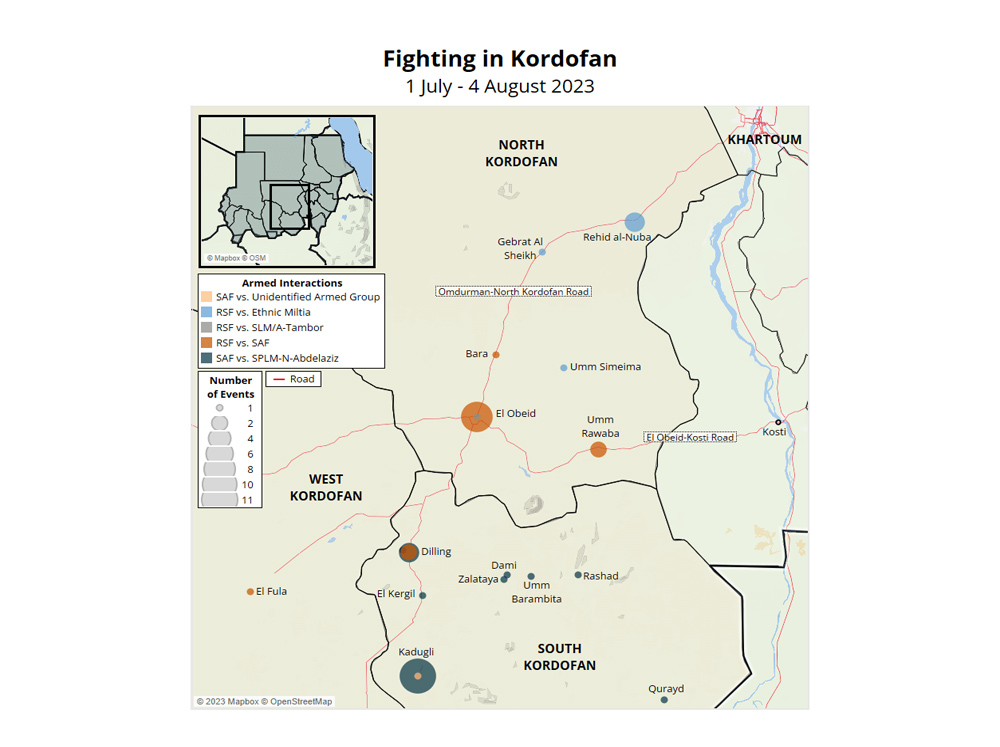
While confirming that Khartoum remains the center of violence since the beginning of the conflict, with over 260 armed clashes and more than 520 reported deaths during the covered period, the scope of the war has expanded. South Kordofan has risen to the second position after Khartoum, witnessing more than 20 armed clashes and at least 55 reported deaths.
The report mentioned that the cities of Al-Obied and Rahid Al-Nuba have become hotspots of fighting in North Kordofan, while recent clashes have mainly focused on the towns of Kadugli and Al-Dalang in South Kordofan.
The center pointed out that the Rapid Support Forces and the faction of Abdul Aziz Al-Hilu, affiliated with the Sudan Peoples Liberation Movement-North, continue to expand their control over areas in Darfur and South Kordofan, respectively.
The center reported that clashes between the army and the Sudan Peoples Liberation Movement-North have decreased by half compared to the previous three weeks of the reported period.
In July of the previous year, the Sudan Peoples Liberation Movement-North managed to seize over ten sites in South Kordofan.
The center confirmed the involvement of the Peoples Defense Forces and militias loyal to the government in fighting against the Sudan Peoples Liberation Movement-North and warned that the current situation casts doubt on the ability of the Sudanese Armed Forces to sustain simultaneous confrontations against both the Rapid Support Forces and the Al-Hilu faction.
In light of the expanding scope of the war, the center expressed concern about the involvement of more active parties in the fighting, which will increase the risk of a long-term war with devastating consequences for the Sudanese population.
It added that the intensification of hostilities and the involvement of more armed groups will exacerbate deep divisions within Sudanese society, meaning that the existing political and humanitarian crisis will continue to worsen.
