
Updated: 0 December 0000 00:00:00
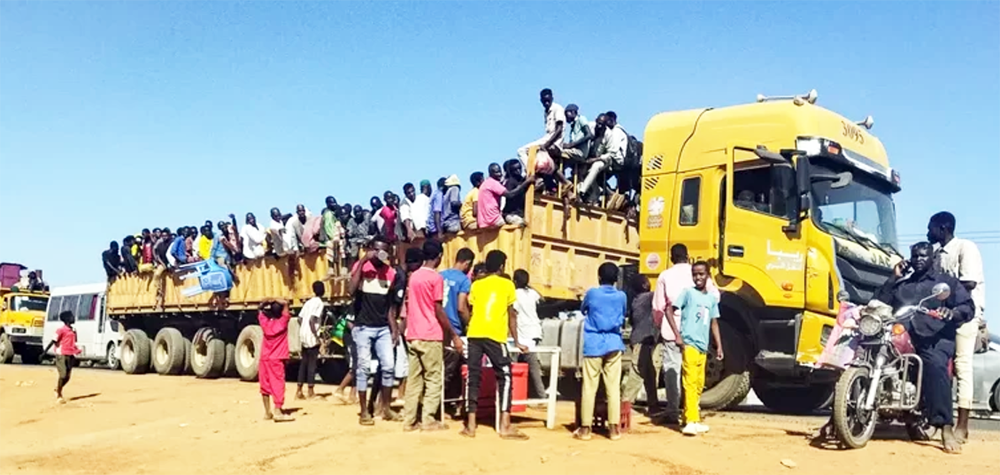
The RSF ignores warnings.. What is the strategic importance of its control over eastern Wad Madani?
Moatinoon
Despite warnings and pressure on the Rapid Support Command after the expansion of the war and the limitation of its expansion, it extended its control over the city of Wade Madani, the capital of the island state.
After battles and skirmishes that have continued since last Saturday, RSF crossed the Kabri Hantop link between the citys east and west.
According to the International Organization for Migration (IOM), some 300 thousand citizens have been displaced from a civilian in the past four days, while many patients with cancer, heart and kidney failure suffer from a lack of health care due to the impact of the battles.
Warnings of war expansion
The United States of America and the United Nations had warned the Rapid Support Forces (RSF) not to overrun a civilian cordial as a centre for displaced persons from the Khartoum war, with the largest treatment, health care and human services centres, and the catastrophic consequences for civilians of the prolonged war in the islands state.
In a statement to its embassy in Khartoum today, Washington urged its call on the Sudanese army and the Rapid Support Forces to end the fighting, allow humanitarian access and fulfil their duties in accordance with international humanitarian law and respect for human rights.
On Tuesday, the Chairperson of the African Union Commission, Musa Faki, called on the warring parties in the Sudan to immediately cease fighting and participate in peace negotiations.
In a statement, Faki expressed concern about the deteriorating security situation in the Sudan following the extension of fighting between the army and the Rapid Support Forces (RSF) into the central city and city of Madani, Al Jazeera State, and the renewed attacks on the Abu Shouk displaced persons camp in Northern Darfur.
The attacks on the camp where displaced persons had lived in Darfur for 20 years had opened old wounds, while at the same time noting that attacks in the city of Wade Madani had opened a new front.
He called on the army and the Rapid Support Forces to cease fighting immediately and engage in peace negotiations, stressing the African Unions readiness to work with all parties to end the conflict in the Sudan.
For its part, the Civil Democratic Front CDF Coordinator warned against the prolongation and continuation of the cycle of war to aggravate the suffering of the Sudanese and lead to the fragmentation of the Sudan.
The member of the Executive Office of CDF, Rasha Awad, said at the beginning of the Coordination Executive Office meetings in Nairobi, "There will be no decisive military victory for any party and the continuation of the war means the aggravation of the humanitarian disaster and its extension to the safe areas," noting that the main objective of the war is to abort the December revolution and restore the people to military control, adding:”
At the meeting, the representative of the Executive Office cautioned that the parties to the conflict had proved to be irresponsible in the light of the massive violations against civilians and that they had not committed themselves to any of their commitments at the Jeddah Forum to protect civilians.
Rasha Awad stressed that the key entry point for defeating the war speech, preserving the unity of the Sudan and achieving sustainable peace is the unity of the democratic forces, in a platform representing Sudanese diversity and its hopes for stopping the war and achieving the objectives of the December revolution, which requires an institutional bearer of the Sudans peace and democratic transformation project.
Strategic importance of an eastern civilian
The Rapid Support Forces (RSF) appear to have been planning early on the East Civilian area and overall lining. This region is of strategic importance for the movement and control of its forces in the areas of central and eastern Sudan. The highway of rapid support from eastern Khartoum to Wad Madani pass Wad Hassouna region to east of Tempul is part of a historic road linking Fazugli mines to the Kingdom of Marwai.
Prior to the construction of the asphalt roads, it was the commercial road linking Al-Qadarif, the Nile Shindi River and beyond. It also connects East Blue Nile and Kassala areas through a road passing the areas of Al-Sabbagh and Khor Jarad, ending in New Hlfa.
From the village of Umm Shang Haj Ibrahim there is a dirt road known as lorries owners and smugglers, and Umm Shang is located 25 kilometres north-east of a civilian.
This road can be reached from Wad Madani to Al-Gadarif in only about an hour and a half. From this same point, Shandi can be reached in two and a half hours, with no military and security presence intercepted by transit.
From the Tandab point, 30 kilos east of Tempul, an ally can be reached within one hour, one hour and a half to Kassala.
This review shows the significance of this route, which is known only by veterans of the bootleg drivers. The same road, through East Blue Nile, can reach Sinnar and Damazin.
Controlling a road of this importance makes it easier for the RSF to make leaps and bounds to the said cities, and it can even block the Port Sudan road. In addition, this deployment opens doors to supply lines from the State of Eritrea, its only obstacle is the large lining on the Atbara River, which is located in the area of control of the 3rd Division in Khashm al-Gerba or via Zero at the end of the elephant forest east of Al-Gadarif, including two bridges Ali State and Atbara rivers. If they cross, space opens to Eritrea or Ethiopia in Tegray region.
The extension towards Sennar opens a door to a supply line from Ethiopia, both across its borders with Sennar State and Blue Nile State.
Above all, the Rapid Support Forces (RSF) control an area where arms trade is active, known as those who invest in such trade if they have to deal with this category.
Adjustment of power scales
Writer Abdullah Rizk Abusimaza says that what happened in Wade Madani City Al Jazeera state capital, on Monday afternoon, 18 December 2023, where the 1st Division and 1st Brigade withdrew from their positions in the city and its east, in Hantop, and then the RSFs entry into it, Without fighting, virtually, and far from cheating, for which some turn to explain some unfavourable developments as envisaged as a new strategy for the armed forces, Since the end of October, by avoiding direct confrontations with the RSF, as required by field requirements.
He added to "Moatinoon" that this tactic, as part of the military leaderships adherence to the option of military settlement, did not begin with withdrawal from a civilian, and may not end with it. This tactic emerged when the armed forces withdrew from Zalingei, Central Darfur, around 31 October 2023, and then in Um Kadada, Northern Darfur, on 8 November, and in Al Daein, Eastern Darfur, on 21 November this year.
"It is a tactic that implies a reversal of the military resolution option, which has been adopted by the armys leadership. As this option expands, it will force leadership to reconsider and consider negotiation as an alternative. " According to Rizk.
The Rapid Support Forces advancement towards the rest of the army camps in the rest of the cities and states meant an expansion of the geography of war and an increase in displacement of nationals at the national level. "The rapid takeover of the islands state will also place many other states, notably the states of Sennar, White Nile, El Gedaref and possibly the Nile River, among the forefront of the potential objectives of rapid support, on the crescendo of a civilian incident, and to dispel the relative safety it enjoyed."
Rizk argued that the consequences of the civilian battle, which ended with the withdrawal of the army, would bring about a modification, whatever its size, of the balance of power on the ground that might have implications for the negotiating process, hosted by Jeddahs platform, some time ago.
He said: "If rapid support from a civilian, through Al-Qadarif, progresses towards Port Sudan, it will, in fact, come close to military decisiveness, resulting in the procedural cancellation or exclusion of his rival as a second party to the negotiating process, or at least weakening it, if the negotiation itself is not cancelled as an option, it remains on the table as an agreed alternative to military solution."
