
Updated: 29 September 2025 12:27:18
A Mother Carries Sudan’s Tomorrow Through Her Children
Moatinoon Follow up
Source: IOM
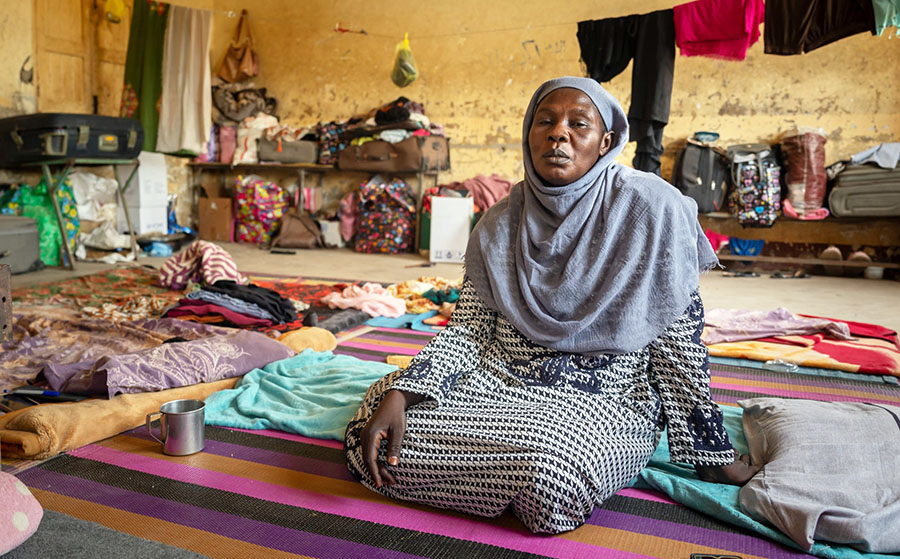
In the crowded displacement site of Abu Shouk in North Darfur, a thin sheet of plastic stretched between two wooden poles serves as the only shelter for Jamila and her four children. Beneath it, she sits on a fraying mat, her youngest daughter curled against her lap, small hands clutching the folds of her mother’s dress.
Around her, the camp moves to the rhythms of survival under the scorching sun. Dust swirls in the late afternoon wind, catching in Jamila’s scarf, but she doesn’t seem to notice. At just 37 years old, her face carries the weight of grief and responsibility far beyond her years.
Life was not always this way. Jamila grew up in Zalingei, a town in Central Darfur, where she and her husband ran a small grocery shop. It was not much, she explains, but it gave them dignity. The shop provided food for their family and a place for neighbors to gather. Evenings often ended with cups of tea, children playing outside, and the comfort of routine.
“When I see a grocery shop now,” Jamila says, her voice lowering, “it reminds me of my old life and that makes me sad.”
War shattered that life overnight. One morning, as clashes escalated in her neighborhood, a shell struck her house. The blast flattened the building and reduced her small shop to rubble. In those same days, her husband disappeared without a trace. She searched desperately, going from neighbor to neighbor, pleading for news. None came.
To this day, she does not know if he is alive or dead.
Alone and with four young children looking to her for protection, Jamila made the agonizing decision to flee. She packed what little she could, loaded it onto a donkey cart, and began walking north. The journey took two days under a relentless sun. At night, she spread a thin cloth on the ground so the children could rest, listening to their stomachs growl with hunger.
At one point, with nothing left to feed them, she sold the donkey – her only means of transport – just to buy food.
“We survived on beans with water,” she recalls. “I prayed it would be enough to keep the children alive until we found safety.”
Abu Shouk camp became that fragile refuge, though life here is precarious. Jamila now survives by working in other people’s homes, washing clothes, cleaning floors, and fetching water in exchange for a little food. It’s never enough. During the rainy season, when the roads turn to mud and work is harder to find, her family often goes hungry.
“If I don’t find work, my children will go hungry, get sick, or even die,” she says, her voice tightening. “They have no one else but me.”
The memories of her escape still haunt her. “The hardest part was the horror, the hunger, the uncertainty,” she explains. “Each step away from Zalingei felt like stepping further into the unknown. No husband, no home, no guarantee of tomorrow.”
Yet even in the face of such loss, Jamila’s strength has not faltered. “I won’t allow my children to starve,” she says firmly.
Jamila’s story mirrors that of millions of others. Sudan is now gripped by one of the largest displacement crises in the world. As of August 2025, more than 14 million people have been displaced by the war both inside and across borders, with Darfur bearing some of the heaviest scars.
Families like Jamila’s have scattered across towns and camps, seeking refuge wherever they can, including to neigbouring countries. Some have begun to return to places they believe safer, even if those towns remain pockmarked by conflict. Over two million people have gone back since the beginning of the year, clinging to the hope of rebuilding among the ruins.
Jamila longs to be among them, but her house is gone, her shop destroyed, her husband still missing. For now, the camp is the only place she can keep her children alive. “More than anything, I wish for the war to stop, for people to feel safe again, and for the world to give us more support.”
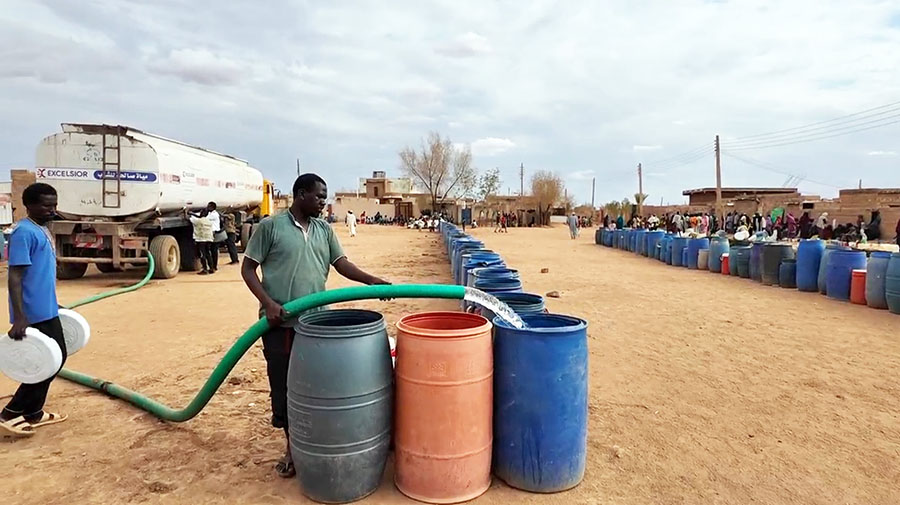
Humanitarian organizations and partners continue to reach communities with clean water, shelter, health care, and mental health and psychosocial support, but the needs are staggering and far outpace the resources available. For every family able to return, countless more remain trapped in displacement, suspended between survival today and uncertainty tomorrow.
As the sun dips over Abu Shouk, Jamila’s children tug at her scarf, asking when they will eat. She gathers them close, smoothing their hair with hands hardened from work. Her eyes betray exhaustion, but her voice is steady. She has lost her husband, her home, and the life she once knew but not her resolve. In her promise to keep her children alive, Jamila carries both her own strength and Sudan’s fragile hope for a future beyond war.

