
Updated: 30 September 2025 15:12:11
Stories of Mothers Fighting for Their Children
Follow-ups - Moatinoon
Since April 2023, the conflict in Sudan has torn apart peoples lives and livelihoods, destroying agriculture, disrupting trade, and forcing more than 12 million people from their homes. As the fighting continues, food prices have skyrocketed, making it increasingly difficult for people to provide food for their children.
More than half the population now faces severe levels of food insecurity and malnutrition, making Sudan one of the worst food insecure countries in the world.
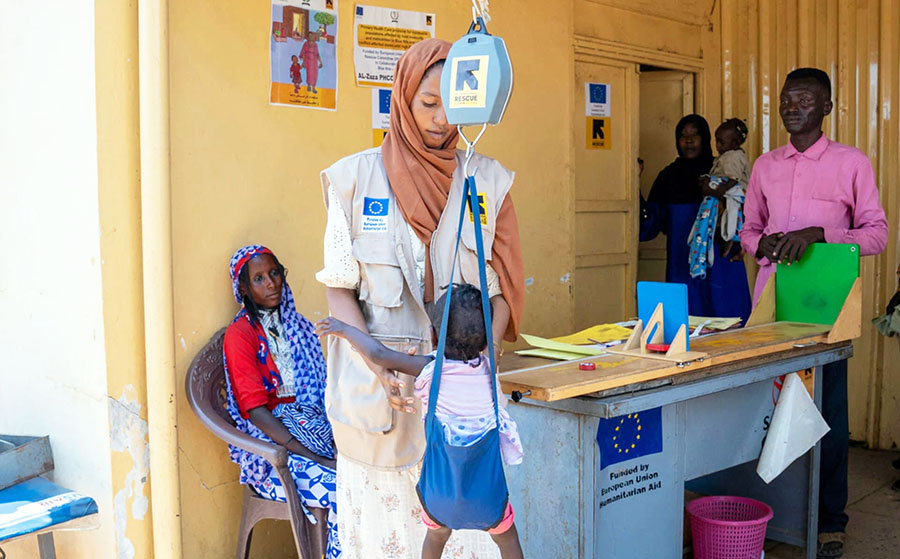
The International Rescue Committee (IRC) has published the stories of three mothers, each struggling to give their children a chance at health and hope.

Halima’s story
In a remote village in Sudan’s Blue Nile Region where healthcare facilities are scarce, Halima was left feeling helpless as her two-year-old daughter Zainab battled malnutrition.
Despite her persisting fever and relentless crying, there was no doctor nearby for Halima to take her to. Their food insecurity only worsened conditions. “We dont eat much. We cook porridge, sometimes pudding,” says Halima. “For us, if we eat in the morning we wont eat again until evening.”
Even their livestock couldnt provide proper nutrition: “The cows are skinny now,” Halima explains. “Their milk wont support a sick child.”
Halima eventually discovered the IRC medical clinic through community observation. “I just saw other mothers taking their children there and I followed them," she recalls. At the clinic, her daughter was quickly diagnosed and enrolled in a malnutrition treatment program.
“We feed her the nutrition pack. One in the morning and the other in the afternoon. It has been one week since we started feeding her the packs," Halima says, describing the Ready-to-Use Therapeutic Food treatment. The IRCs emergency interventions in Sudan, supported by European Union funding, have become a lifeline for families like Halimas.
Shama’s story
Some displaced families in Sudan make long and difficult journeys to get to safety. When Shama’s family was displaced, they were forced to travel for four days until they reached her parents house in Al-Garri, where they now live.
Her son Anwar, who was only three months old at the time, became ill during the arduous journey. Shama managed to find a doctor, who was also fleeing, and she gave her son medication which relieved his symptoms. During this time, the family subsisted on lentils, fish and soup, but Shama avoided feeding these to him, fearing he would not be able to digest them.
Upon their arrival in Al-Garri his health began to decline again. “He was very skinny. He was not able to sit and was unable to move his body,” Shama recalls.
Shama took Anwar to the IRC’s medical clinic where they did check ups, diagnosed him with malnutrition and promptly began treatment. “The malnutrition unit weighed him, and gave him Ready-to-Use Therapeutic Food (RUTF) packs. They prescribed two and a half packs a day. When his health improved, it was reduced to one pack a day,” she explains.
Gradually, Anwar’s condition began to improve. “Now he’s much better. He’s getting back to his normal self, as healthy as the rest of his siblings,” she tells us.
Anwar still suffers the effects of his previous malnourished state, which led to growth delays. But Shama remains positive: “I wish to see him walking, playing with his siblings, and running around. That’s what I hope for.”
Hawaya’s story
Hawaya and her family are among those who have been forced from their home. Her son, Wayel, after contracting malaria, began experiencing symptoms of diarrhea and vomiting, while refusing to eat solid food. “I didn’t know my son was malnourished,” Hawaya explains, “And no matter what food we gave him, he was continuously losing weight.”
Hawaya discovered the IRC’s medical clinic, where she took him to be treated for malaria. She then visited the malnutrition unit, where he was screened and diagnosed with acute malnutrition. The nutrition team gave Hawaya advice on food hygiene and a feeding regimen alongside the Ready-to-Use Therapeutic Food (RUTF) packs to begin her son’s treatment.
“When he took these medications, he got better. His fever lowered. His health is now improving,” she tells us. “We are still feeding him therapeutic meals. His body was deteriorating. But now, thank God, his health has recovered. His hair is also regaining its color.”
The medical advice and meal planning has significantly aided Wayel’s recovery from malnutrition. Hawaya observes his improvements day by day: He just used to cry all the time. But now he plays with other children in the yard.”

