
Updated: 6 November 2025 17:17:10
How fake content about the Sudan war spreads
Source: DW
While atrocities against civilians and combatants alike remain a sad reality of Sudans brutal civil war, some of the most viral content around the conflict doesnt show what it claims to show. DW takes a closer look.
When it comes to calculating the number of victims in the brutal civil war in Sudan, precise figures are hard to come by.
But whether 20,000, up to 150,000 or even 200,000 people have been killed since the start of the conflict in April 2023, its clear that atrocities, including mass rape, have been committed on a huge scale ― in particular by the rebel paramilitary Rapid Support Forces (RSF), which have been accused of genocide, ethnic cleansing and crimes against humanity by international actors including the United Nations and the government of the United States.
Predictably, social media is awash with content purporting to show evidence of these atrocities. Sometimes, the content is indeed accurate. Often, however, its not Fake, misleading and artificially-generated content abound.
"This war is also very much taking place on social media, where disinformation is being spread in the wildest forms," explains Volker Perthes, former Special Representative of the Secretary-General of the United Nations for Sudan from 2021-2023.
"Depending on which side different activists are on, they blame the war and various massacres on the opposing side — or on the US or the UN," he tells DW. "Its all very hate-filled."
Claim: "This video shows the UAE-backed RSF terrorizing a mother and her children in Sudan."
At the end of October, a viral video claimed to show a Sudanese mother and her three children cowering in front of RSF troops who, it was insinuated in several social media posts, were firing their weapons at or near her, prompting the woman to flinch in fear.
On October 29, an account on X which describes itself as an "independent analyst" of geopolitics, international affairs and breaking news posted the video, which it said showed "the UAE-backed RSF terrorizing a mother and her children in Sudan." The video has since been viewed almost 13 million times, liked more than 80,000 times and reposted more than 41,000 times.
On October 30, the same video was included in a post describing the fall of the city of el-Fasher to the RSF and the subsequent atrocities reportedly committed.
"A Sudanese woman and her children are being threatened with death by UAE-backed Rapid Support Forces (RSF) militias," read an insert. The post has been viewed almost 30,000 times.
On October 31, the video was picked up by prominent Syrian internet personality Jamil Al-Hasaan who embedded it in a video of himself which he posted on his Instagram channel (where he has more than 2.4 million followers and where the video accrued almost 450,000 likes) and his X account (where he has almost 400,000 followers and where the video has been viewed almost one million times).
"Save our people in Fasher in Sudan, be their loud voice," he wrote on each platform. In the version of the video embedded in his plea, a caption in Arabic reads: "The mother was trying to carry [protect] her child." In a five-minute long plea, Al-Hasaan claims several times, without evidence, that the woman in the video was ultimately killed.
Finally, later on October 31, Al-Hasaans video, including the embedded video of the Sudanese mother, was further shared by an X account describing itself as an "alternative news agency" where it racked up another 800,000 views.
However, the initial video doesnt show what the various accounts say it does.
A reverse image search for several screenshots from the video reveals that it was originally posted on TikTok on September 12 ― more than a month before the capture of el-Fasher by the RSF and therefore contrary to the narrative offered by at least two of the accounts which reposted it.
Furthermore, local language experts from DWs Arabic desk have confirmed some of the dialogue audible in the video which suggests that the men are not members of the RSF, but rather belong to the Sudanese Armed Forces (SAF). They dont appear to be threatening the woman, but are rather asking her where she is from and whether she is linked to the RSF. The woman replies that she is part of the Zaghawa tribe and that the RSF arrested her husband.
While she initially appears to flinch at the sound of gunfire, the shots dont appear to be that close, but rather further away, and not directed at her. Whats more, about 25 seconds into the video, an adult hand appears from behind the camera and briefly takes the hand of the little boy in a manner which appears more comforting than threatening. Indeed, from this point, the mother appears slightly calmer.
Claims that the woman and her children were subsequently killed are unsubstantiated and impossible to prove.
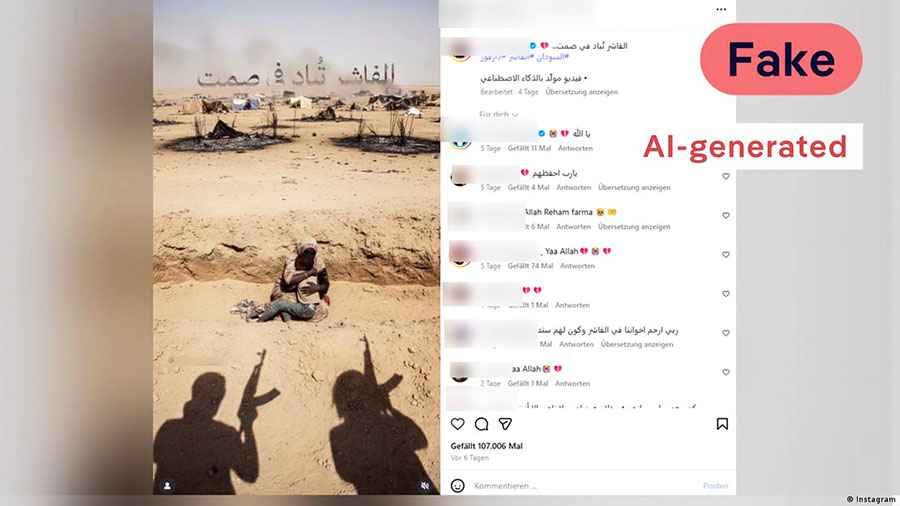
In the video posted by the Syrian commentator Al-Hasaan, the footage of the woman and her children isnt the only embedded clip; Al-Hasaan also comments on a second clip which appears to show a woman holding a young child and cowering in a desert trench before two armed soldiers, depicted as shadows cast from behind the camera.
A reverse image search for a screenshot of the clip reveals that the motif has been posted hundreds of times on various social media platforms over the past week, including here (almost 150,000 views) and here (over 12,000 views).
The clip, however, is entirely fake and was generated using artificial intelligence.
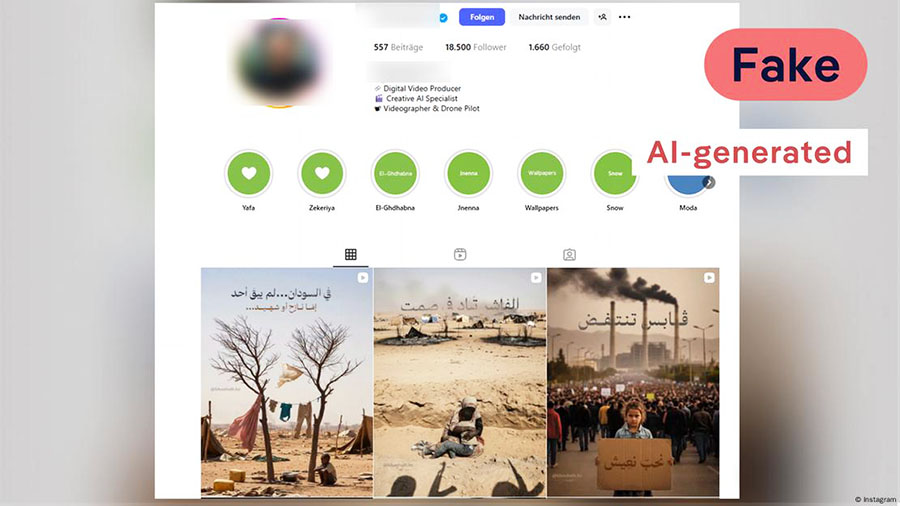
Not only do the soldiers "shadows" not move, the boys trousers also change colour slightly. And if those clues werent obvious enough, the clip even features the creators watermark: @khoubaib.bz, an Instagram account belonging to Khoubaib Ben Ziou, a self-described "Creative AI specialist."
Ben Ziou posted the clip on October 28 along with an explicit note that it was "AI generated," but this didnt prevent it from accruing almost 110,000 likes or Al-Hasaan from using it in his video.
Sudan: disinformation and fake news
DW asked both Jamil Al-Hasaan and Khoubaib Ben Ziou whether they were aware that they were spreading inaccurate and AI-generated content, or that their AI content was spread as something real. DW also asked what their motivation was, but received no response.
"Disinformation is a huge problem in Sudan," says Gerrit Kurtz, a conflict researcher at the German Institute for International and Security Affairs (SWP) in Berlin, with a particular focus on the Horn of Africa. "Media literacy isnt particularly high. Then again, the availability of social media and the internet in rural areas is limited."
Disinformation coming out of Sudan appears to be aimed more at the outside world, where numerous foreign powers all have stakes in the strategically-located and mineral-rich country.
"There are close personal ties between the leadership of the RSF and political leaders in the United Arab Emirates (UAE)," explains Kurtz.
"The warring parties are constantly posting their narratives on their own channels. Telegram is popular, Hemedti [RSF General Mohamed Hamdan Dagalo] is on [US President Donald Trumps] Truth Social, the SAF and their allies are on Facebook and X."
But while the disinformation battle rages online, its ordinary people on the ground who are suffering in real life.

