
Updated: 17 November 2025 15:40:50
Khartoum’s Demolition of Unplanned Housing: A Government-Led War by Administrative Measures

By Ma’ab Al-Mirghani
Khartoum – (Jabraka News)
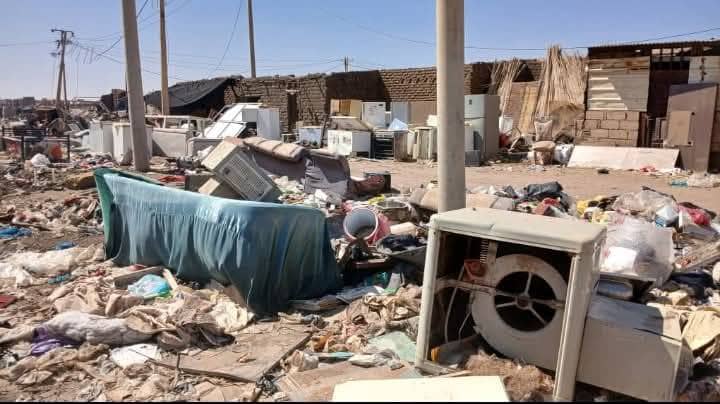
Khartoum State has recently carried out a sweeping campaign to demolish unplanned housing—commonly and dismissively referred to as “informal settlements”—in Mandela, Al-Sareeha, Al-Faitab, Al-Aziba, Al-Khairat, and other areas. The campaign has sparked a heated debate between affected residents, local authorities, and rights advocates over the legality and fairness of the measures.
Jabraka News spoke with several residents whose homes were demolished. Their testimonies reveal the severe human suffering caused by the loss of shelter, livelihoods, and the uncertainty surrounding their future.
“Our Lives Collapsed Overnight”
Mohamed Al-Tayeb (a pseudonym for his safety) says his life was shattered on the morning of 19 October 2025, the day his family lost their home in Mandela, in the Mayo district south of the beltway, where they had lived since 1997.
He told Jabraka News that the authorities began by marking homes with warnings, giving residents only 72 hours to evacuate the place that held decades of memories. Once the deadline expired, forces from the Joint Security Task Force—along with police and the army—arrived, turning the neighborhood, as he described it, “into a scene of fear and chaos.”
Homes were not only demolished, but residents were verbally abused and accused of supporting the Rapid Support Forces (RSF) during their presence in Khartoum—even though most of them are long-time displaced people from Darfur and the Nuba Mountains.
Mohamed says the demolition left them feeling helpless. Many families scattered among relatives, others were forced to rent, and many more were left sleeping in the open after the neighborhood was reduced to a barren expanse.
“The government gave us no assistance, no alternative housing—nothing,” he said. “We were treated as if we were a burden they wanted to get rid of.”
With nowhere to go, Mohamed’s extended family of 26 people remained in the same neighborhood, building makeshift shelters where their home once stood. He recalls arriving in Mandela in 1997 after his father fled violence in El Geneina. “What happened is not just the loss of a home,” he said. “It’s a continuation of the displacement that has haunted us for decades.”
Mandela was once home to more than 1,600 families. Now, fewer than 500 remain; the rest have dispersed across Khartoum and to the country’s peripheries.
“It Could Have Been Positive—But It Wasn’t”
In Al-Sareeha Block 5, another resident recounts receiving a 72-hour eviction notice before authorities arrived to demolish homes without providing any relocation plan, support, or compensation.
He told Jabraka News that most residents had no option but to rent homes despite already difficult economic conditions. “There are no services, no healthcare, nothing. People simply had to fend for themselves.”
He temporarily relocated to Al-Jerif, trying to rebuild some stability, but says the process could have been positive had it included alternative plots or proper resettlement planning. “Instead, it left people with absolutely nothing.”
A Displaced Woman Faces Loss After Loss
Another resident—now living in a displacement camp in Kosti after fleeing the April war between the army and RSF—shared her story of double tragedy.
She told Jabraka News that her informal home in Al-Fitehab burned down after being struck by an explosive shell, destroying everything she owned. The house, built next to a mosque, collapsed on her during the fire. She also lost her only source of income when her motorized rickshaw was stolen.
She had hoped to return to Khartoum, but with the authorities removing all “informal housing,” and her former neighborhood now razed, she says returning is impossible.
She recalls the sight of the fire: “The images alone were enough to break me,” she said. Still, she struggles to remain strong for her children.
“All I ask for now is a simple place to live—a shelter to keep my children safe. What happened to me is the story of many Sudanese who lost both their homes and their livelihoods.”
Political and Official Reactions
The Sudanese Congress Party in Khartoum condemned the demolitions in Mandela, describing them as a crime against humanity, and held local authorities and state police responsible. The party called for an immediate investigation, compensation for affected families, and guarantees against future forced evictions.
It stressed that solutions must preserve human dignity and take into account people’s economic and social conditions, rather than “coercive policies that only deepen the suffering of the poor.”
Meanwhile, according to the state-run SUNA news agency, the Khartoum State Land Protection and Waste Removal Authority announced the completion of the first phase of demolitions in Jebel Aulia locality, including Mandela, Ghaboush, and Qalb Al-Asad in Mayo.
Authority director Abdelaziz Abdullah said the aim was urban expansion, proper planning, and improved service delivery, asserting that the operation was carried out “smoothly and without injuries,” thanks to the professionalism of staff and security forces. He noted that the next phase would include areas in Al-Wihda and Al-Madina Al-Khayriya.
Contradictions and a Deepening Crisis
The crisis highlights a stark contradiction between residents’ experiences—marked by loss, displacement, and the absence of alternatives—and official statements portraying the process as orderly, development-oriented, and necessary for better urban planning.
It also echoes political voices warning that the demolitions constitute a serious social injustice and a violation of basic human rights.
Editorial Note
- The Sudan Media Forum and its member institutions publish this report, prepared by Jabraka News, to reflect the real and escalating suffering of vulnerable citizens who not only endure the consequences of war but also lose their homes to state-led demolition campaigns that classify them as “informal settlements.”
The report also revives the pressing debate on the right to housing and the government’s responsibility to accommodate citizen-led solutions when it cannot provide alternatives.
