
Updated: 22 November 2025 16:15:48
Sudan’s War: When Civilian Bodies Became Battlefields

Malak Jamal Balla, Khartoum – (Ilamyat Network)
The war that erupted on April 15 was never merely a military confrontation between two armed forces. It quickly turned into an open assault on civilians—poisoning the air they breathe, blocking the roads they travel, and striking at their bodies and senses at the very core of their existence.
Indiscriminate artillery shells, suffocating gases, direct gunfire, and relentless drone attacks have left thousands of civilians without limbs, hearing, sight—or life—during a war that has never distinguished between fighter and civilian.
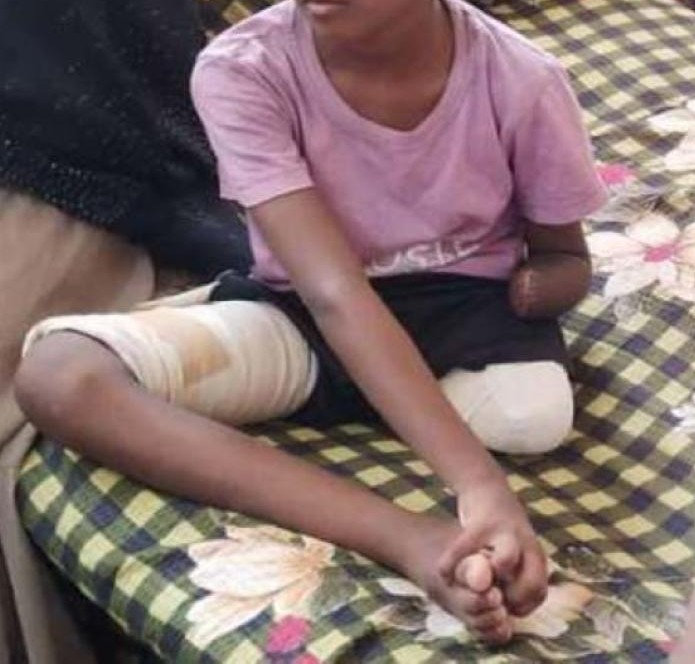
Rami… A Young Man Who Lost His Leg to a Shell
On one of the war’s early mornings, Rami Al-Hadi stood near the wall of a school in Omdurman’s Al-Thawrat neighborhood. The school guard shouted to him, “Rami, things are getting bad—get down!” Moments later, an artillery shell struck near Rami, severing his leg cleanly below the knee.
“I felt nothing,” Rami recalls. “I saw my leg lying there and couldn’t believe it. I was in complete shock.”
That same day, Al-Nau Hospital in Omdurman received a large number of dead and wounded—many with amputations—after hours of relentless shelling from dawn until late afternoon, an unusually long barrage that overwhelmed the few remaining hospitals.
Heavy and Banned Weapons… Civilians as Targets
Reports by Human Rights Watch have documented widespread disregard for the laws of war by both parties. Explosive weapons were used in populated areas despite international humanitarian law prohibiting the use of high-explosive munitions in residential neighborhoods. These include exploding bullets, expanding ammunition, blinding lasers, anti-personnel mines, cluster munitions, and certain types of toxic gases considered internationally prohibited.
Civilian testimonies confirm that many injuries resulted from weapons causing severe tearing and destruction of limbs and tissue.
Exploding Skulls and Bullets Tearing Through Bodies
Mohamed, a resident of Kafouri, ventured out during heavy clashes to buy food from Al-Noor complex. While cycling, he saw Rapid Support Forces (RSF) fighters stop a man and execute him with a point-blank shot to the head—his brain exploding before Mohamed’s eyes.
“I froze,” he says. “When I tried to turn back, one of them shouted at me. I fled, and they fired more than ten shots. One hit my shoulder, another struck my back—just two centimeters from my spine—puncturing my lung.”
Mohamed spent months without proper care before traveling to South Sudan and then India. Doctors there could not remove the bullet lodged deep in his back. He remains stranded due to the prohibitive cost of treatment.
Fatima… Toxic Fumes Took Her Sight
In Khartoum’s Mayo district, a series of airstrikes on the Yarmouk military factory, oil factories, and the truck compound sent thick smoke billowing for days.
Suad (a pseudonym), a resident of the area, recounts how her mother, Fatima, lost her eyesight after days in the fumes.
“A gray layer formed over her eyes,” she says. “She kept saying everything looked blurred. Within two days, she went completely blind.”
Doctors confirm that gases released by heavy weapons can cause severe eye irritation, conjunctivitis, and even destruction of the optic nerve leading to permanent blindness.
Dr. Mujahid Hilali—who worked in Um Al-Qura and Al-Jabalain hospitals—describes a disturbing pattern among displaced people:
“Thousands woke up unable to open their eyes. Severe infections resembling acute conjunctivitis made vision impossible. Some recovered; many lost their sight forever.”
Poor health conditions, dust, toxic fumes, and smoke have made blindness widespread among the displaced—alongside limb loss from shelling and hearing loss from repeated explosions.
The Sound of Explosions Stealing Hearing
Dr. Fayhaa recalls treating a father and son at the Turkish Hospital in Khartoum who lost their hearing after standing near an artillery piece that fired suddenly.
“They arrived complaining of intense pressure in the ears,” she says. “They could barely hear anything—everything sounded distant. Within hours, both went completely deaf.”
According to her diagnosis, the blast wave had destroyed the eardrum and the tiny auditory bones.
Ismail Yahya, a worker in the Goro Market, was also near a drone strike. The explosion shattered the bones of his middle ear. With no medical care available due to the security situation, he had to treat the bleeding ear by improvised means. When he finally saw a specialist, he discovered the bones were completely damaged—he now needs a hearing device he cannot afford.
In Wad Madani, Taj Al-Deen faced a similar fate. On his way to Friday prayers in 2024, RSF fighters ordered him to stop. Unable to hear them amid the noise, they assumed he was fleeing and shot him twice in the leg, resulting in a complete amputation. His story demonstrates that the loss of senses in this war not only leads to disability—it can cost a person their life.
Numbers That Speak the Pain
Dr. Anas Al-Hassan, orthopedic surgery registrar at Al-Nau Hospital, reveals that artillery shelling—known locally as al-tadween—occurs eight to nine days each month on average. On every such day, the hospital receives three to four new amputations.
Some patients arrive with limbs already severed or crushed beyond repair—bones, veins, and muscles shredded “as if passed through a grinder,” he says—leaving immediate amputation as the only option.
During intense shelling in Al-Thawra, operating rooms recorded up to eighteen amputations within hours. On one day of shelling in Sabreen Market alone, ten to fifteen amputations were performed. Head injuries were the deadliest—90% resulted in death or irreversible brain damage.
Since the war began, the hospital has averaged around twenty amputations per month, mostly lower limbs. There were twenty hand amputations in just a few months, and 18–20 below-knee amputations in September and October 2023, before numbers declined slightly as shelling decreased.
A War That Robs Civilians of Everything
These testimonies are not isolated stories. They are fragments of a larger reality—a war that has stripped civilians of everything: safety, senses, limbs, and often life itself.
As weapons continue to crush what remains of the cities, survivors struggle to rebuild shattered bodies and memories heavy with pain.
With peace still elusive, the most urgent question persists:
How many bodies must be torn apart, how many eyes must be blinded, before this open wound stops bleeding?
- This report is published by the Sudan Media Forum and its member institutions, prepared by Ilamyat Network, to expose the physical, psychological, and material devastation inflicted by a war that makes no distinction between military and civilian targets. For those who did not lose their lives or loved ones, the cost may be the loss of a limb, sight, or hearing. As bombardment and explosions continue, documenting these violations and amplifying the voices of survivors is an urgent necessity—not only to aid those who remain, but to confront those responsible with the true magnitude of what they have wrought.
