
Updated: 11 January 2026 15:13:01
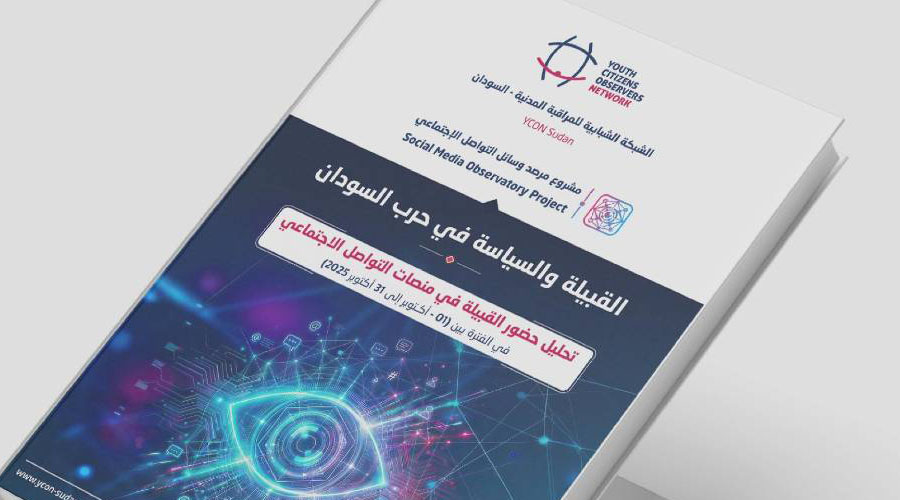
YCON Sudan Report: “Tribal Discourse” as a Weapon in Sudan’s War
By Ameer Babiker Abdallah
Source: Ultra Sawt
The Youth Network for Civil Monitoring has recently released a significant report shedding light on the powerful presence of tribal identity on social media platforms in Sudan during the ongoing war.
Titled “Tribe and Politics in Sudan’s War,” the report offers an in-depth reading of the role of the digital sphere in reproducing and politicizing tribal identities during the war that erupted on 15 April 2023. It reveals a profound transformation of the tribe from a traditional social framework into an influential digital political actor. Rather than treating tribal discourse as an isolated linguistic phenomenon, the report places it at the heart of the war’s dynamics—as a tool for mobilization, polarization, and the reshaping of collective consciousness. This approach grants the report analytical value that goes beyond descriptive monitoring to interrogate the deeper structures of the conflict.
General Context
The importance of the report lies in its engagement with one of the most sensitive issues in the Sudanese context: the complex relationship between tribe and politics in times of war. While many analyses have focused on military or geopolitical dimensions, this report deconstructs the symbolic and discursive aspects of the conflict, centering social media as a primary arena for meaning-making. In doing so, it fills a clear gap in contemporary Sudanese studies, which often underestimate the digital sphere or treat it merely as a reflective platform rather than an independent actor.
The report employs a mixed methodology combining quantitative and qualitative analysis of content from 120 influential pages and accounts across Facebook, X (formerly Twitter), and TikTok during October 2025. This methodology stands out as one of the report’s core strengths, enabling the identification of general trends while also unpacking the deeper meanings and contextual nuances of the discourse. The use of a specialized digital tool (Junkipedia) further enhances data reliability and reduces the subjectivity that often characterizes studies of digital discourse.
More importantly, the methodology demonstrates a clear ethical and legal awareness, particularly in handling content that includes hate speech and incitement to violence. This methodological rigor adds seriousness and responsibility to the report, positioning it as a credible reference for future research.
The Tribe as a Digital Political Actor
The findings reveal that 83.3% of the analyzed tribal posts appeared in a directly political context, and that 78% of this political presence was linked to the war. These figures do not merely indicate incidental politicization of the tribe; they point to a structural transformation in its role within the digital sphere. As the report shows, the tribe is no longer invoked solely as a social identity, but increasingly as a political bloc to which positions are attributed, collective responsibilities assigned, and which is used as a tool for legitimization or denunciation.
At its core, this transformation reflects the crisis of the Sudanese nation-state. As trust in official institutions erodes and systems of protection and public services collapse, the tribe resurfaces to fill the void—not only on the ground, but also in the digital space, where its role is reformulated through new language and modern tools.
Hate Speech and the Framing of War
One of the report’s most critical conclusions is that 82% of tribal content contained one or more forms of hate speech or racism. However, the analytical value lies not in the figure itself, but in the deconstruction of the nature of this discourse. The report demonstrates that hate speech is not expressed as isolated individual outbursts, but is systematically reproduced within collective narratives that frame the war as a conflict between population groups rather than between political or military actors.
Dangerous patterns emerge here, including dehumanization, incitement to violence, and tribal segmentation. These patterns do not merely distort perceptions of the “other”; they psychologically and morally prepare the ground for justifying violence against them. In this sense, digital discourse becomes part of the machinery of war, not merely an echo of it.
Amplifying Polarization
The report also draws attention to the role of digital algorithms in amplifying the most emotionally charged and polarizing content, thereby reproducing “us versus them” binaries on a wide scale. This observation is particularly significant because it shifts the discussion from individual user responsibility to the technical architecture of the platforms themselves. As presented in the report, the digital space is not neutral; by design, it privileges content that generates engagement—even when that content promotes hate or incites violence.
Implications and Future Outlook
The report warns that the persistence of this pattern of discourse poses a direct threat to any project aimed at building sustainable peace or achieving a democratic political transition. When the tribe advances as the primary source of legitimacy and protection, and the logic of citizenship and institutions recedes, imagining a post-war state becomes increasingly difficult. Moreover, the deepening of digital hatred leaves long-term scars on the social fabric that extend well beyond the duration of the war itself.
In conclusion, “Tribe and Politics in Sudan’s War” does more than diagnose a phenomenon; it offers an analytical framework for understanding it and raises fundamental questions about the future of public discourse in Sudan. Its core strength lies in linking the digital with the political, discourse with violence, and identity with war. In this sense, it is not merely a monitoring report, but an intellectual document worthy of discussion and engagement—one that provides a necessary foundation for any effort to dismantle the roots of the conflict and to build an alternative discourse grounded in citizenship, justice, and peace.

