
Updated: 10 February 2026 14:53:44
The Presence of Eastern Sudanese Women: An Anthropological Reading
By Khadiga Mustafa
Researcher in Social Justice Issues
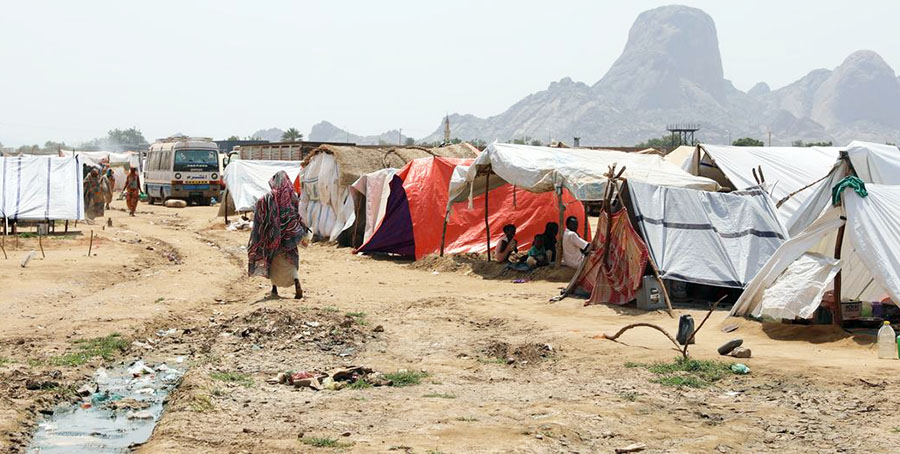
For decades, Eastern Sudan has experienced a prolonged state of fragility resulting from cumulative intermittent conflicts, tribal tensions, and the deterioration of basic services. With the outbreak of the war on April 15, 2023, displacement became a structural part of daily life. Thousands of families were forced to flee conflict zones toward areas perceived as relatively safe in the Eastern Sudanese states, as well as the River Nile and Northern states.
However, war-related displacement to Eastern Sudan did not occur within a stable context; rather, it compounded a long history of annual displacement caused by floods, particularly in areas like Al-Faw and the Gash Delta. This doubling of the environmental disaster was clearly manifested in the Red Sea State in 2024. Even after the war began, the region witnessed several major flood incidents—most notably in the Tokar and Al-Qanab wa al-Olib localities—alongside one of the most dangerous disasters following the collapse of the Arba’at Dam. This led to massive internal displacement, the destruction of homes, and the interruption of healthcare monitoring, particularly for pregnant women.
In these intersecting environments of war, flooding, and the collapse of health infrastructure, women emerge as the most vulnerable group. They face a total loss of medical follow-up during pregnancy, childbirth in unequipped locations, and a complete absence of emergency services in rural localities.
Reproductive Health in the Context of Medical Collapse
Reproductive health is among the sectors most severely affected in Eastern Sudan. Data from the United Nations Population Fund (UNFPA) indicates that more than 1.75 million women and girls in Sudan require urgent reproductive health services. Furthermore, the World Health Organization (WHO) expects over 1.1 million births to occur within a single year amidst the near-total collapse of the health system. The HeRAMS survey shows that less than 30% of health facilities are capable of providing basic reproductive health services on a regular basis.
In this context, the "untrained" midwife does not represent a mere traditional actor in the birthing process; she is an integral part of an alternative care system that arose historically in the absence of development. From an anthropological perspective, the presence of the traditional midwife cannot be explained simply as a continuation of "old customs," but rather as a rational social response to the absence of the formal health system and the need for a trusted, available mediator embedded within the social fabric.
The traditional midwife operates within a complex network of relationships: she knows the medical and social history of the women, moves through neighborhoods or villages without barriers, is available at any time for a limited cost, and works within community support systems that help provide medical supplies or transportation costs when necessary.
Alternative Care as a Feminist System
"Alternative care" refers to the set of social practices and mechanisms developed by a community to compensate for the weakness or absence of formal services, particularly in health, social support, and crisis management. It is an integrated system based on the production of local knowledge, social networking, and daily risk management.
Within this structure, Al-Salif emerges as one of the most important tools for community solidarity. Al-Salif is a system of economic and social support in which both women and men participate. It involves providing financial sums or in-kind resources periodically or upon need, aiming to help families face crises or cover emergency medical needs. Al-Salif is not merely a "financial association" (savings circle); it is a community mechanism for redistributing resources in environments where government services are weak.
Although men participate in the Salif system, women control its intricate details. This transforms it into a tool of alternative care—a feminist instrument for managing fragility that turns limited resources into a collective capacity to protect bodies during moments of vulnerability.
As a local system of financial and social exchange, Al-Salif acts as a daily mechanism for reproducing relationships. Its role is not limited to providing resources for care or reproductive health; it also forms a space where small tensions are managed and bonds between families are repaired. Anthropologically, Al-Salif can be understood as part of a "moral economy" based on mutual obligation, where financial contributions become tools for rearranging relationships and maintaining social balance.
This role makes Al-Salif a daily extension of Al-Qald, the traditional reconciliation system used to restore balance after major conflicts. While Al-Qald operates at the group level through compensation and symbolic recognition, Al-Salif operates at the level of daily life through small obligations that keep relationships cohesive.
Anthropological literature regarding Al-Qald has often focused on the roles of men and tribal leaders, overlooking the presence of women within these systems. Women often appear on the margins as part of the "social background" of the reconciliation, rather than as active elements in its production. However, a closer reading reveals that the presence of women constitutes the emotional and social infrastructure that allows Al-Salif and Al-Qald to function. Through organizing Salif cycles, hosting visits, and managing the daily rituals surrounding reconciliation, women create the social climate that enables Al-Qald to perform its function and grants Al-Salif its ability to maintain relationships. In this sense, the presence of women is a structural element in the system of reconciliation and care, even if traditional literature fails to recognize it.
Al-Sharifa Maryam: A Model for Women’s Participation in Fragile Spaces
Modern Sudanese political history has not seen a prominent presence of Eastern Sudanese women in the public sphere. Political narratives have remained confined to major religious houses and central elites, while women in the East remained outside the archives and official political memory.
This absence does not reflect a lack of action as much as a lack of documentation. Fragile societies often produce active women who work outside institutional frameworks, yet written history fails to notice them.
In this context, Al-Sharifa Maryam stands out as a model of a woman who was not recorded in official political history but left a social impact exceeding that of many political actors. Her presence in Sinkat, Suakin, and Port Sudan revealed another form of feminist participation—one practiced through mediation, care, conflict management, and resource redistribution. These practices constitute the essence of social policy.
Despite her passing, her memory remains present as a guardian of the social fabric. The annual Hawliya (commemoration) of Al-Sharifa Maryam serves as an active social center that allows women to participate in a public space, despite the restrictions imposed on them elsewhere. This center acts as a mechanism for reconciliation and the renewal of social ties, where women exercise an undeclared negotiating role through which relationships are managed, conflicts are resolved, and social balances are reformulated to enhance local stability.
The life of Al-Sharifa Maryam reveals that reconciliation in Eastern Sudan is not managed solely through Al-Qald as a formal institution, but also through unwritten feminist practices. Among the most important of these is the feminist song, which acts as a symbolic negotiation tool. The songs women chant during occasions or visits are not merely aesthetic expressions; they are social discourses carrying messages about shame, generosity, reconciliation, and respect, redefining the boundaries of the acceptable and the rejected. In moments of tension, a song can function as an "emotional mediator" that opens the door for dialogue, softens anger, or reminds parties of the groups values.
While men lead the formal reconciliation scene, women work vigorously to recondition relationships, soften stances, and craft a shared symbolic language through song and daily rituals. This presence is what gives reconciliation its ability to persist, making women the invisible architects of the social fabric.
Feminist Initiatives: A Contemporary Extension
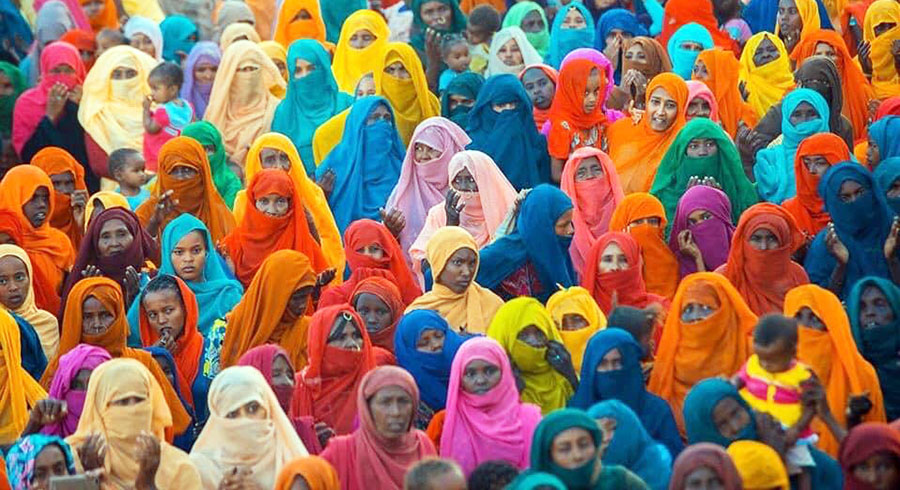
Women in Eastern Sudan form an undeclared organizational network that manages resources, coordinates relationships, and provides social protection during events and crises. This network operates outside formal structures but has proven effective in managing events, distributing resources, containing conflicts, and supporting the most vulnerable women. Lived experiences in the East reveal the ability of women to build flexible support systems that reproduce daily life and fill the gaps left by the state through an alternative care system.
This informal organization found a contemporary extension in womens development associations and feminist initiatives that have emerged in recent years, especially after 2018. These initiatives work with the same spirit but different tools. Such initiatives include, but are not limited to: The Feminist Forum, The Gadarif Students Gathering, The Eastern Sudan Womens Gathering, Teknan Association, The Eastern Sudan Women’s Development Mechanism, and the March 8 Association.
The March 8 Feminist Association stands out as one of the organizations closest to the context of the Red Sea State. Its membership includes local women working on issues of gender, womens education, and community peace.
Areej Hussein, the director of the association and a filmmaker working on feminist issues, points out that the initiative arose from a genuine need to create a safe space for women and provide direct support in an environment suffering from poor services. Areej also works on organizing feminist events and supporting the documentation of women’s initiatives, considering documentation an essential part of protecting feminist memory and granting women a presence in the record of public work.
Areej explains that feminist initiatives in Eastern Sudan operate with extremely limited resources but perform monumental work in a highly fragile context. They provide psychological and social support, organize awareness workshops in the field of womens development, and coordinate relief initiatives for womens needs—such as "dignity kits" during displacement and floods—alongside producing documentary materials that preserve womens experiences and highlight their social impact. However, these initiatives face significant challenges in localizing humanitarian and developmental work. International organizations often impose complex standards and procedures that do not align with the capacities of local initiatives, creating a gap between actual needs on the ground and bureaucratic requirements.
Areej also notes the existence of an entire generation of young women eager to volunteer in women’s development, but they face a lack of training, weak capacity-building opportunities, and an absence of clear pathways for engagement in humanitarian work. Despite this, feminist initiatives continue to operate, relying on local solidarity networks, women’s expertise in managing daily crises, and, to a large extent, community support.
The experience of Eastern Sudan shows that women, despite the fragility of the context, transform into primary actors in managing daily life and crises. From Al-Salif to traditional midwives and feminist initiatives, these networks form an alternative care system that compensates for the absence of the state and protects society from its own vulnerability. Recognizing and supporting their role is the key to any sustainable response, making the local voice of women the centerpiece of protection and development.

