
Updated: 14 February 2026 20:29:26

Saheeh Masr Reveals Details of the Death of a Sudanese Minor in Cairo Detention
Moatinoon
The platform Saheeh Masr, run by an independent Egyptian journalistic team, published details about the detention and death of the teenager Al-Natheer in one of Egypt’s detention facilities in Badr City, Cairo, after Egyptian police arrested him during ongoing campaigns targeting Sudanese nationals in recent months.
According to the report, the Sudanese teenager Al-Natheer Al-Sadiq had been standing with friends in front of his residence in Cairo, carrying documents proving his legal status in Egypt as well as a UN High Commissioner for Refugees card.
Al-Natheer was not hiding anything and was not fleeing, his family told Saheeh Masr. Yet on January 18 he was suddenly arrested without charges.
From that moment began a detention ordeal that lasted 25 days inside the Badr Police Station, ending in his death—an incident that sparked widespread debate on social media in recent hours after activists circulated his family’s account of his harsh detention conditions.
His family told Saheeh Masr that he had been in the ninth grade in Khartoum, Sudan, when the horrors of war forced them to flee in 2023 in search of safety, leaving relatives and friends behind, believing Egypt would be their place of refuge.
But that journey to safety never reached its end. The family described the moment of his arrest as shocking: “There was no charge… he had documents, his status was legal.” Nevertheless, he was taken to the station and remained there until he breathed his last, turning his story from a search for safety into one that ended in confinement.
25 Days in the Cold and Waiting
According to what the family was told, Al-Natheer was not held inside a closed room but in an exposed outdoor yard outside the buildings, facing the harsh winter cold without heavy clothing to protect him, without blankets, and without proper bedding. They said he did not receive sufficient food or water, in conditions they described as lacking even the minimum humanitarian standards.
The shock, they added, was not only about the harsh environment but also the nature of the detention itself. They were informed he was held with adults, including individuals accused in criminal cases. “A teenager detained beside adult suspects,” the family said, questioning how their son—who had not yet turned eighteen—could be kept in an environment that did not match his age or legal status.
After 25 days in detention, one day before his death, his mother visited him at Badr Police Station, where she was allowed to see him every Friday. During that visit he appeared exhausted. He told her he felt ill and that his chest hurt badly from the cold, asking her to bring antibiotics next time. The family says he developed a chest infection due to cold exposure and poor detention conditions. She brought the medicine on her next visit, which turned out to be the last.
About a day after that visit, while she hoped the medication would ease his pain, she received a call from the police station informing her of her son’s death. She was asked to go to the prosecution office to complete burial procedures and receive the body, which had been transferred to Badr Hospital and then to the Zeinhom morgue. It was Thursday night, February 12, 2026, inside Badr Police Station—where a detention that began without charges ended in the loss of a life.
Endless Fear… Family Demands the Truth
A family member told Saheeh Masr that grief was not the only thing that filled the home after his death—fear was there as well. His older brother now remains inside the house, as the family fears he too could be arrested if he goes out. They even hesitated to let him go to the Zeinhom morgue to say a final farewell, fearing that a moment of mourning might turn into a new tragedy.
A relative added: “He was a child… regardless of his nationality or status, he had the right to safety, dignity, and protection under international law.”
The family is calling for an independent and transparent investigation into the circumstances of his detention and death, and for accountability if any wrongdoing is proven, so the tragedy does not happen again.
A Repeated Tragedy in Recent Days
In a related development, on February 5, 2026, a Sudanese elderly man named Mubarak Qamar Al-Din Majzoub Abdullah, aged 67, also died inside El-Shorouk Police Station in Cairo after nine days of detention. He had been arrested during a wide security campaign targeting refugees, asylum seekers, and migrants in Egypt in recent months, which intensified at the beginning of this year.
Mubarak held an asylum-seeker card issued by the UNHCR office in Egypt in October 2025, valid until April 2027. This granted him a clear legal status as an asylum seeker under international protection, which prohibits arbitrary arrest or detention solely because of migrant or refugee status, in accordance with Egypt’s Asylum Law No. 164 of 2024, the principle of non-refoulement, and the prohibition of discrimination.
According to documentation by the Refugees Platform in Egypt, he was stopped on January 26, 2026 while buying household supplies—a pattern they say is common in targeting refugees—without explanation or legal justification, in explicit violation of Article 54 of the Egyptian Constitution, which requires a reasoned judicial order to restrict liberty, notification of arrest reasons, and immediate access to family and legal counsel.
He had documentation showing he had applied for a residency permit, including a reference registration number with the Ministry of Foreign Affairs and an appointment set for September 2, 2027 to receive the permit, which negates any legal basis for treating him as a person violating residency rules or targeting him for his administrative status.
He too was detained under inhumane conditions at El-Shorouk Police Station, including severe overcrowding, lack of suitable sleeping space, poor ventilation, and deprivation—along with other detainees—of immediate and regular medical care, despite clear signs of deterioration in his health during detention. His family had previously stated they were not promptly informed of his worsening condition and were not given a real opportunity to monitor his health or transfer him in time to a suitable hospital.
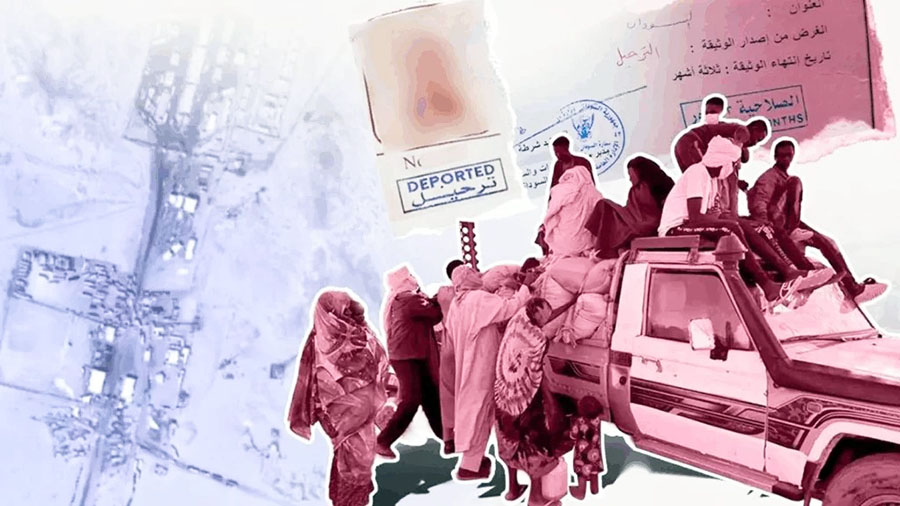
Reports by the Refugees Platform in Egypt, along with rights and journalistic organizations, documented a significant expansion of arrest, detention, and deportation campaigns from border crossings and transit points to major Egyptian cities during 2024 and the first half of 2025. These campaigns intensified further in the second half of 2025 and into early 2026, with recurring patterns of confiscating UNHCR cards, disregarding refugee status, and deporting thousands of Sudanese fleeing war.
The platform recorded the detention of hundreds of Sudanese between April and August 2025 in Greater Cairo, Alexandria, and Matrouh, in addition to more than 1,500 detention-and-deportation cases since August of that year, in an escalating trajectory culminating in late 2025 with the largest campaign of its kind.
These cases included refugees and asylum seekers holding UNHCR cards. Some reported confiscation of those cards during detention and even alteration or falsification of their file photos to portray them as individuals apprehended near borders without documents or protection—constituting a grave violation of the non-refoulement principle and basic procedural safeguards guaranteeing the right to effective legal review before any removal measure.

