
Updated: 16 February 2026 09:40:10
Continental Efforts to Stop the War in Sudan and Achieve Comprehensive Peace
Moatinoon — News Report
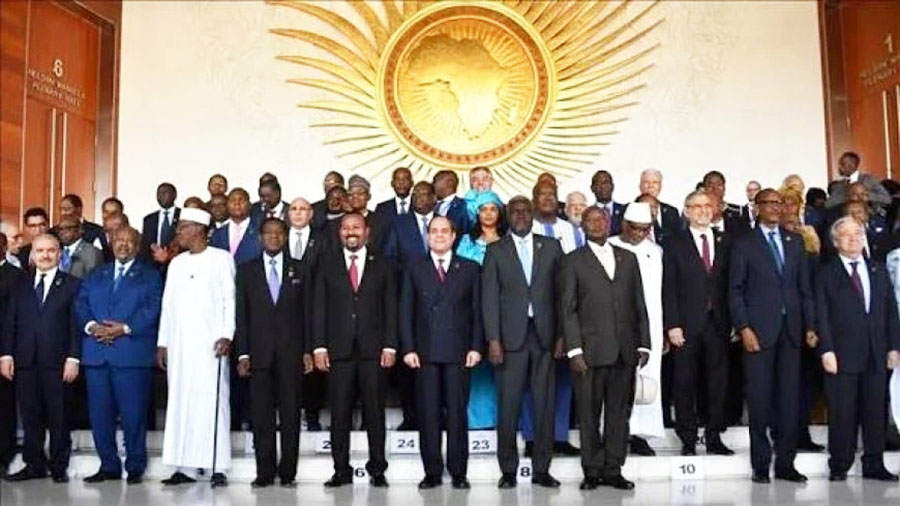
At the conclusion of the 39th African Summit, held in the Ethiopian capital Addis Ababa under the theme “Peace, Security and Development,” African heads of state and government convened to discuss the continent’s most pressing challenges, foremost among them the Sudanese crisis that has continued since April 2023 between the Sudanese army and the Rapid Support Forces.
Ongoing Condemnation of Violence in Sudan
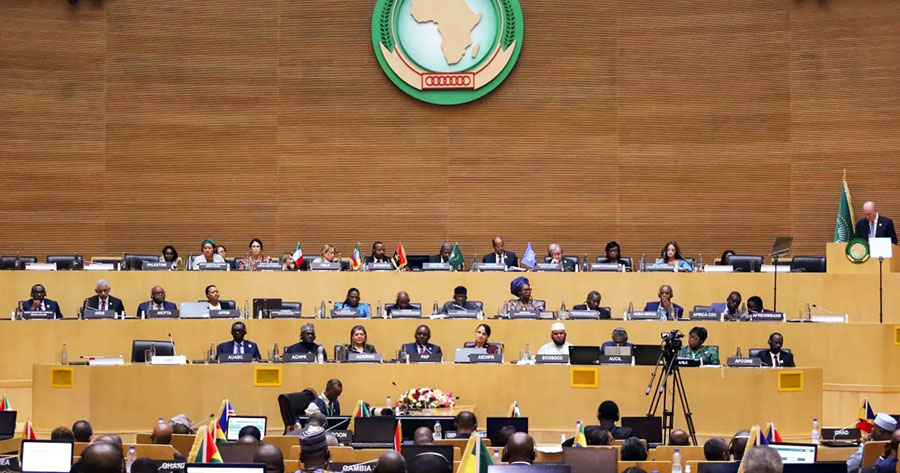
The African Union Peace and Security Council discussed the situation in Sudan during ministerial meetings held on the sidelines of the summit under Egypt’s chairmanship, with the participation of several African states and international organizations. The communiqué adopted by the Council expressed categorical rejection of violence and mass killings targeting civilians, as well as rejection of the “parallel government” announced by the Rapid Support Forces alliance, considering it a threat to Sudan’s unity and stability.
At its meeting on 12 February 2026, the Council stressed:
The continuation of Sudan’s suspension from African Union membership since October 2021 until the restoration of a “legitimate, democratic civilian government.”
A call for a humanitarian truce and arrangements for an immediate ceasefire as a prelude to an inclusive Sudanese dialogue led by Sudanese actors.
Reaffirmation of support for Sudan’s sovereignty, unity, territorial integrity, and a democratic political transition led by civilians.
A call to hold violators of international law accountable and to respect civilian rights.
Background of the Suspension
The Council and the Summit explicitly confirmed the decision to maintain Sudan’s suspension from the African Union, which has been in effect since October 2021. Sudan has not met the conditions required for reinstatement, foremost among them restoring a full civilian constitutional order, forming a civilian-led transitional authority, and achieving tangible progress in a comprehensive political process.
The suspension was originally imposed following the exceptional measures taken by the military in October 2021, which the Union considered a departure from constitutional order, in violation of the African Union’s charter rejecting unconstitutional changes of government. This principle is one of the organization’s core rules and has previously been applied to other countries that experienced coups or unconstitutional transitions.
Leaders also reviewed field reports indicating continued fighting between the Sudanese army and the Rapid Support Forces, worsening humanitarian conditions, expanding displacement, difficulties in aid delivery, and risks of state institutional collapse.
The Council described the situation as a serious threat to regional and continental security, not merely an internal crisis.
African Calls for Political Transition
During deliberations, the Council called for an immediate ceasefire and humanitarian truce under the supervision of the African Union, the United Nations, and other regional and international partners, as well as respect for human rights and facilitation of aid access to affected populations.
The Council supported the Sudanese National Peace Initiative plan, which includes a ceasefire, withdrawal of irregular armed forces, and a timetable for their dismantlement. It also urged a return to legitimate institutions and an expansion of political dialogue with the participation of all Sudanese forces.
In this context, the AU Commissioner for Political Affairs, Peace and Security, Bankole Adeoye, called on the continent to assume responsibility for leading mediation efforts and creating conditions for a peaceful and inclusive transition.
In press remarks, he stressed the need to launch dialogue among all political actors in Sudan, noting that all ongoing efforts aim to exert pressure for a peaceful solution and that all stakeholders are working toward a comprehensive, immediate, and permanent ceasefire and toward ending all wars in Sudan.
Positions of Participating African States
Positions among participating countries varied. Egypt and other regional states affirmed their support for Sudan’s sovereignty and unity and their desire to end the conflict as quickly as possible through political solutions.
Some observers criticized the African Union for slow procedures and for failing to impose effective enforcement mechanisms, particularly amid continued multi-party external support to the warring sides.
Since the outbreak of internal conflict between the Sudanese army and the Rapid Support Forces, Sudan has faced a severe humanitarian crisis, including rising levels of famine, displacement, and violations of civilian rights. This has prompted African leaders to treat the issue as a continental crisis in defense of security and stability.
The 39th Summit concluded by reaffirming the continent’s commitment to ending the conflict in Sudan and calling on all parties to respond to African–UN initiatives, reflecting a balanced approach that warns against continued war while encouraging political and humanitarian pathways. Nevertheless, the road to lasting peace in Sudan remains contingent on implementing these decisions on the ground and on the cooperation of the conflict parties with African and international mediators.

