
Updated: 20 February 2026 10:07:38
For the Third Consecutive Year… War Smoke Obscures Tayeb Salih’s Presence in Khartoum’s Sky
Moatinoon
For the third year in a row, the anniversary of the passing of world-renowned Sudanese writer Tayeb Salih arrives under a heavy domestic cultural silence, after the war that has continued since April 2023 halted one of the country’s most important literary events: the Tayeb Salih International Prize for Creative Writing, which had been an annual cultural season celebrated by intellectual circles inside and outside Khartoum.
Once again, on the anniversary of Salih’s death—which coincides with the founding of the prize—the Board of Trustees, chaired by Ali Mohamed Shamo, announced that the exceptional circumstances Sudan is going through because of the war have led to the suspension of events since April 15, 2023. They noted that the scale of destruction affecting cultural institutions—museums, libraries, theaters, and archives—has made holding activities extremely difficult.
The prize, founded in 2010 at the initiative of Zain, had within a few years become a global platform bringing together writers and critics from Africa and the Arab world. It contributed to publishing nearly one hundred books by winning authors, strengthening Sudan’s literary presence regionally and internationally.
The Question of Life and Survival
The prize’s Secretary-General, Majzoub Eidrous, told Moatinoon that organizing a cultural celebration amid scenes of killing, destruction, and mass displacement raises an ethical question before it is an organizational one. He asked about the value of celebration while millions suffer displacement, homelessness, and institutional collapse.
His statement reflects a deep cultural dilemma: can culture continue as an act of life in a time dominated by the question of survival?
Novelist and poet Bushra al-Fadil described the suspension of the prize as a natural result of the dominance of the sound of weapons over the sound of words, affirming that war is by nature an enemy of culture and that creativity flourishes only in peace. He likened the gap caused by the prize’s suspension to what happened to some global awards during major wars.
Short-story writer and poet Mughira Hassan Harbiya saw the disappearance of the prize as reflecting a broader state of darkness and despair, as people’s focus shifted to survival rather than literary events. He noted that cultural infrastructure has nearly collapsed and that creators are living in harsh dispersion between displacement and exile.
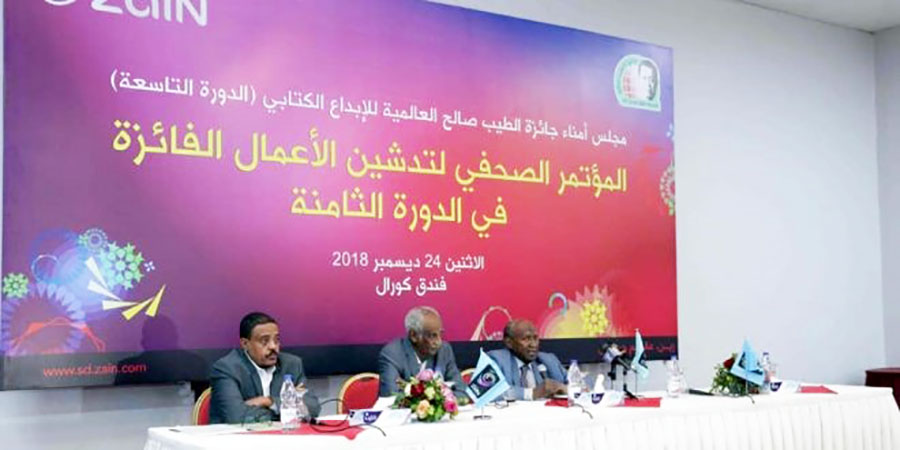
Khartoum… From Buzz to Silence
Before the war, Khartoum hosted gatherings of poets and novelists, art exhibitions, and theater performances, in addition to receiving Arab and African guests annually.
This was described by Moroccan researcher and translator Said Benkrad, a member of the prize’s novel committee, in a blog post titled Visit to Africa, recounting his 2020 trip to Sudan at the invitation of the organizing committee. He wrote:
“On the second day the prize activities began. Its organizers held a symposium on the sidelines of the award ceremony addressing intellectual, literary, and political issues. Attendance was large: intellectuals, politicians, students, and university professors. The hall was packed with people of all ages and both genders—something rare for us except in exceptional cases. The themes were rich and varied. There were many things I did not know about Sudan—its history, its culture, and its deep attachment to Arab civilizational heritage—yet there was also a strong adherence to the heritage of the African continent in every field.”
Today, however, intellectuals describe Khartoum as culturally deserted. Lecture halls have become damaged or closed buildings, and the events that once formed the pulse of intellectual life have disappeared. Publishing houses have been looted and printing presses halted.
Bushra al-Fadil says to Moatinoon, “War works to erase cultural platforms, treating them as unnecessary luxuries for the battlefield, where weapons roar instead of loudspeakers and bullets instead of words.”
Mughira agrees, describing the cultural scene during the war as total devastation: the solid foundations of culture and creativity—cultural centers, publishers of awareness and enlightenment, theaters, libraries, art exhibitions, and gatherings of poets and novelists—have all collapsed, leaving only ruined and looted remnants. It is a bitter and sad reality left by the war, one from whose shock we will not recover soon.
“Khartoum is deserted and creators are scattered widely, living their own ordeal as displaced people, refugees, and strangers to time. War has poisoned everything and erased every meaning of living and contemplation. This is an era of loud noise, vast emptiness, and bullets—not a time for the poet or the painter’s brush. Everything is obscured.” He adds to Moatinoon.
Deferred Hope
Tayeb Salih passed away in London in 2009, but his legacy has remained present through works that embodied the Sudanese environment and introduced the world to its characters and culture. Since the prize was established in his name, his anniversary has become an annual occasion to renew cultural dialogue about the values of tolerance and coexistence reflected in his literature.
The suspension of celebrations in his memory does not mean his influence has disappeared, but it symbolizes the scale of loss suffered by the cultural scene because of the war.
An analysis of Sudan’s cultural landscape over the past three years reveals several clear results: declining cultural production due to displacement and instability; collapse of cultural infrastructure; migration of creators abroad or their preoccupation with securing livelihoods; and the interruption of international events that once connected Sudan to the global cultural scene.
These indicators confirm a historical rule: culture flourishes in peace and withers in war. The Board of Trustees stressed in its statement that the suspension of the prize is temporary and that its return will occur once safe conditions are available to preserve its standards and mission. It affirmed that the return of cultural events is not merely symbolic, but necessary to help rebuild what the war destroyed—materially and morally.
The absence of the Tayeb Salih Prize is not a passing cultural event, but a sign of widespread paralysis affecting intellectual life in Sudan. When a literary platform of this magnitude disappears for three consecutive years, it means that war has not only destroyed stone, but has also struck cultural memory itself. Yet hope remains pinned on the end of the conflict, because culture, as intellectuals repeat, may temporarily vanish beneath the smoke of guns—but it does not die.

