
Updated: 20 February 2026 17:22:13
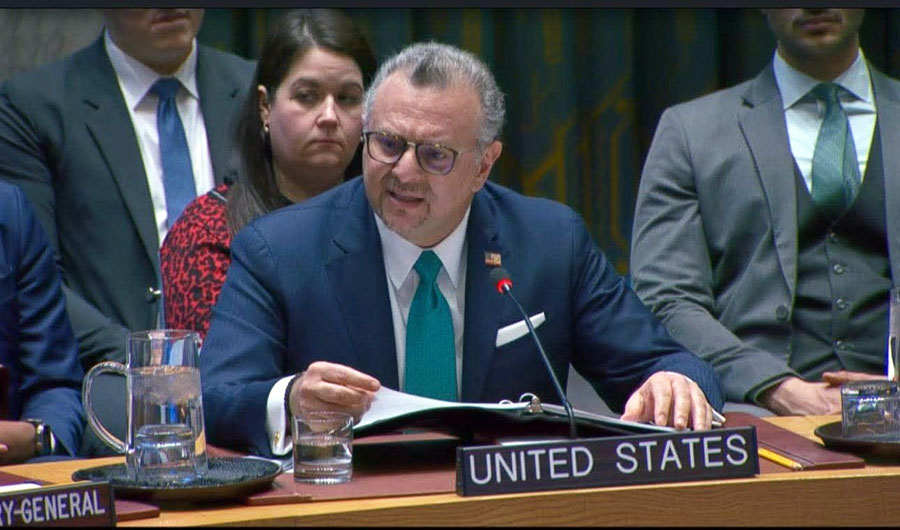
Musaad Boulos: Sudan’s War Must Come to an End
Moatinoon
Musaad Boulos’s speech before the UN Security Council during its latest session on the ongoing war in Sudan drew wide attention across political and media circles, especially amid the continuing conflict between the Sudanese Armed Forces and the Rapid Support Forces and the profound humanitarian and security consequences it has produced. Analysts’ interpretations of the speech were divided: some saw it as a clear American repositioning in managing the crisis, while others viewed it as a continuation of traditional international rhetoric lacking decisive enforcement tools on the ground.
According to a number of experts, Boulos’s address carried a political dimension that went beyond a mere call for a ceasefire. He stressed that a military victory is not a realistic option for ending the conflict and that Sudan’s future must be shaped through a comprehensive civilian political process rather than through military balances of power. Analysts say this stance reflects U.S. awareness that the continuation of war threatens not only Sudan’s unity but the stability of the entire region, particularly given refugee flows, the expansion of war economies, and the spread of weapons. In their view, the speech sought to cement an equation: any future legitimacy in Sudan will not be built on military victory, but on broad political consensus.
Other observers, however, point to a clear gap between the speech’s political aspirations and the complex reality on the ground. The two warring forces continue to bet on achieving military gains that would improve their negotiating positions, making calls for a humanitarian truce or immediate ceasefire closer to a moral appeal than a realistically achievable project in the near term. They note that past experiences have shown how fragile de-escalation agreements in Sudan can be, often collapsing quickly under the pressure of military calculations and shifting local alliances.
Analysts also highlighted the tone of the speech, which appeared firm toward all parties to the conflict. Boulos referred to direct responsibility for serious human rights violations and hinted at the possibility of using political and economic pressure tools against those obstructing peace efforts. Some experts believe these messages carry two dimensions: a moral one aimed at affirming accountability and rejecting impunity, and a political one seeking to redraw international red lines for Sudanese actors. Others, however, warn that threatening sanctions could push some local actors toward greater hardline positions, especially if they feel directly targeted.
Among the points that attracted analysts’ attention was the speech’s focus on a phased solution path—starting with a humanitarian truce, followed by security arrangements, and ultimately leading to a civilian-led political transition. Some observers considered this approach methodologically realistic because it acknowledges the difficulty of an immediate comprehensive political settlement. The challenge, Sudan specialists say, lies in the lack of trust between the parties and the fragmentation of civilian forces themselves, raising questions about who could represent the Sudanese public in any future negotiations.
Regionally, some analysts interpreted the speech as an American attempt to regain the initiative in the Sudan file amid the overlapping roles of various regional powers, each with its own calculations and interests. The war is no longer purely an internal matter; it has become an arena of indirect competition among regional actors through political, logistical, or economic support. From this perspective, Boulos’s speech was directed not only at the warring parties inside Sudan but also at regional capitals concerned with the conflict’s outcome.
Domestically within Sudan, reactions were divided between those who welcomed the emphasis on prioritizing civilian rule, seeing it as international backing for the Sudanese revolution’s demands, and those who regarded the speech as external interference that may not account for the complexities of local power balances. Some analysts argue that any international initiative will fail unless it is rooted in broad Sudanese-Sudanese dialogue that includes political and societal forces and addresses the roots of the crisis—namely the imbalance in the relationship between the military establishment and the civilian state, as well as issues of identity and uneven development.
In conclusion, most analysts agree that Musaad Boulos’s speech constituted a strong political message that the international community has not abandoned Sudan and that the option of open-ended war is internationally unacceptable. At the same time, it faces the dilemma of implementation in an environment marked by multiple centers of power and intertwined internal and external interests. Between the desire to stop the bloodshed and the hard realities on the ground, the effectiveness of any speech ultimately depends on its ability to transform into a coordinated international and regional pressure mechanism and into a political process that finds a Sudanese partner willing to make mutual concessions. Until that happens, the speech will remain an important moment in the trajectory of the crisis, but not necessarily its decisive turning point.
