
Updated: 24 February 2026 22:37:15
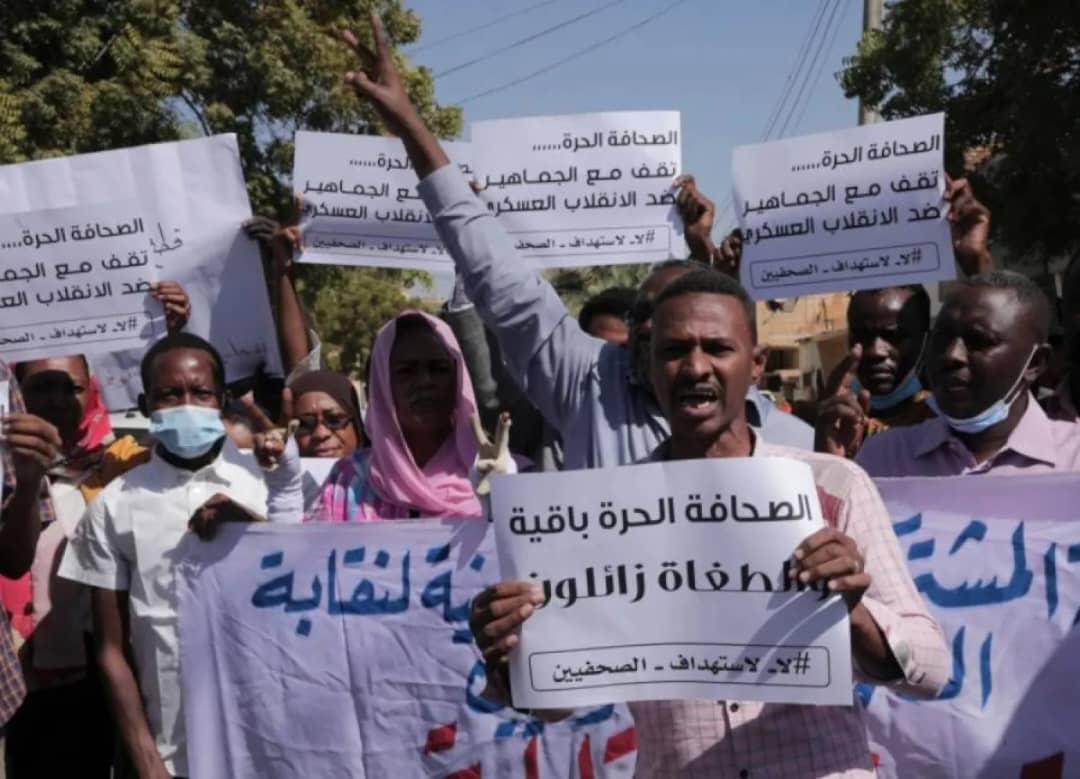
Sudan: 6 Journalists Disappeared and 34 Killed Since the War Began

Youssef Abdullah, Cairo, 23 February 2025 (Newsroom, Sudanese Media Forum) — The Sudanese Journalists Syndicate said that six Sudanese journalists remain forcibly disappeared for varying periods, in addition to seven others facing prolonged detention in Khartoum, Sennar, and the Darfur region. The Syndicate called for their immediate release.
The Syndicate confirmed an unprecedented escalation in both the scale and nature of violations against Sudanese journalists, as well as the expansion of their geographic scope and the multiplicity of actors involved. It stated that this indicates that journalists and media workers have become direct targets within the context of the conflict that has been ongoing in Sudan for three years.
The emergence of these cases represents merely the tip of the iceberg compared to the deteriorating reality journalism in Sudan has reached, where practicing the profession has become extremely difficult. As a result, Sudan has been ranked among the lowest countries in press freedom (151 in 2022, and 156 in 2025).
In 2025 alone, 14 journalists and media workers were killed in Sudan, bringing the total number of journalists killed since fighting erupted between the Sudanese Armed Forces and the Rapid Support Forces in April 2023 to 34. Additionally, six journalists have been subjected to enforced disappearance, seven to prolonged detention, nine to temporary arbitrary arrest and detention, and four to legal prosecution. There have also been eight cross-border violations targeting journalists in countries of refuge, 19 cases of threats, hate speech, and smear campaigns, as well as three institutional decisions and measures restricting journalistic work.
Iman Fadl Al-Sayed, Secretary for Freedoms at the Syndicate, stated that the scale of violations has forced journalists to leave Sudan, and yet some have continued to face violations in host countries, particularly Libya.
A report prepared by the Syndicate and published in late January 2026 concluded that “violations against journalists are no longer merely incidental consequences of fighting; in many cases, they have taken on a systematic character, amid the absence of legal accountability and the continuation of policies of impunity.” The report added that this “constitutes a direct threat to society’s right to know and undermines any genuine prospects for democratic transition and peacebuilding in Sudan.”
The Syndicate said that Issam Mohammed Haroun, Director General of the State Radio and Television Authority in North Darfur; Mustafa Fadl Al-Mawla, Director General of the Central Darfur Radio and Television Authority; as well as Ashraf Al-Habr, Musab Al-Hadi, and Nader Min Allah, have been missing for varying periods between November 2024 and October 2025, and their places of detention remain unknown.
Sudanese people became familiar with the press industry and newspaper circulation in their daily lives in 1903. However, just 120 years later, with the outbreak of war, everything related to this industry was devastated. In reality, the journalism profession had already begun to erode due to decades of dictatorship in the country.
Whenever a military coup emerged (1958, 1969, 1989), it would first move to shut down press institutions. Among the many arrests carried out by coup authorities against political actors, journalists would also face arrest and restrictions on their work.
Finally, after more than a century of push and pull, a brutal and far-reaching war erupted in April 2023 between the Sudanese Armed Forces and the Rapid Support Forces, delivering a painful end to what remained of this long-standing profession in Sudan.
The war was accompanied by widespread destruction of infrastructure and buildings in the capital, Khartoum, in what were unprecedented levels of devastation.
The conflict began in Khartoum and then spread to other cities and regions. Among the millions of civilians who were displaced from the capital or fled to neighboring countries were approximately 700 journalists who had been working in newspapers, television channels, and radio stations. A similar number may have been employed in professions adjacent to journalism.
As a result of this massive displacement and exile, Khartoum was effectively declared a city without journalists, and press institutions ceased functioning. The war there unfolded in darkness; news and factual accuracy slipped through the cracks of an absent journalistic balance, creating conditions conducive to the return of a model of media control dominated by propaganda, misinformation, and non-objective bias toward one side of the war.
Iman Fadl Al-Sayed, Secretary for Press Freedoms at the Syndicate, said that the parties to the conflict exercise significant control over information and are unwilling to provide it. In some cases, they even pursue the sources journalists rely upon.
Overall, the number of violations against journalists since the outbreak of conflict between the Sudanese Armed Forces and the Rapid Support Forces has reached 593 cases, including 34 killings of journalists and their relatives, in addition to injuries from gunfire and shootings.
As a result, more than 20 print newspapers that had been published from Khartoum ceased operations, along with the suspension of all radio stations and television channels due to being caught in crossfire, while armed groups used some of their buildings as military barracks.
In the early months of the war, armed forces (predominantly from the Rapid Support Forces) targeted the homes of male and female journalists across various neighborhoods of the capital, raising fears of a systematic plan against them and their property. This prompted many to flee.
Approximately 70 homes were raided and attacked during May, June, July, and August 2023, according to an early report prepared by the Sudanese Journalists Syndicate on the state of press freedoms in Sudan. The report stated that violations against journalists and media institutions “constituted an obstacle to practicing the profession in a manner that ensures its independence and integrity.” Journalists resorted to self-censorship or refrained from practicing their profession altogether.
In reality, violations against independent media and journalism have continued to increase in Sudan, leading to a severe decline and near collapse of the press. Even before the outbreak of war, the period was marked by increased government censorship and domination by security forces over journalists and media outlets, including the filing of publication-related complaints against journalists and newspapers—most of them driven by vindictiveness. When war broke out in April, journalists were not spared; they died alongside other victims.
- The Sudan Media Forum and its member institutions are publishing this material to reflect the bleak future that Sudanese journalism has reached. The report highlights the killing of 34 journalists since the start of the conflict between the Sudanese Armed Forces and the Rapid Support Forces, including 14 killed in 2025 alone, as well as six cases of enforced disappearance, seven cases of prolonged detention, nine cases of temporary arbitrary arrest and detention, four cases of legal prosecution, eight cross-border violations against journalists in countries of refuge, 19 cases of threats, hate speech and smear campaigns, and three institutional decisions restricting journalistic work.
The Sudan Journalists Syndicate reiterates the unprecedented escalation in both the scale and nature of violations against Sudanese journalists, the expansion of their geographic reach, and the multiplicity of actors involved. The Syndicate stated that this indicates that journalists and media workers have become direct targets in the context of the conflict that has been ongoing in Sudan for three years.
