
Updated: 14 April 2026 09:37:39
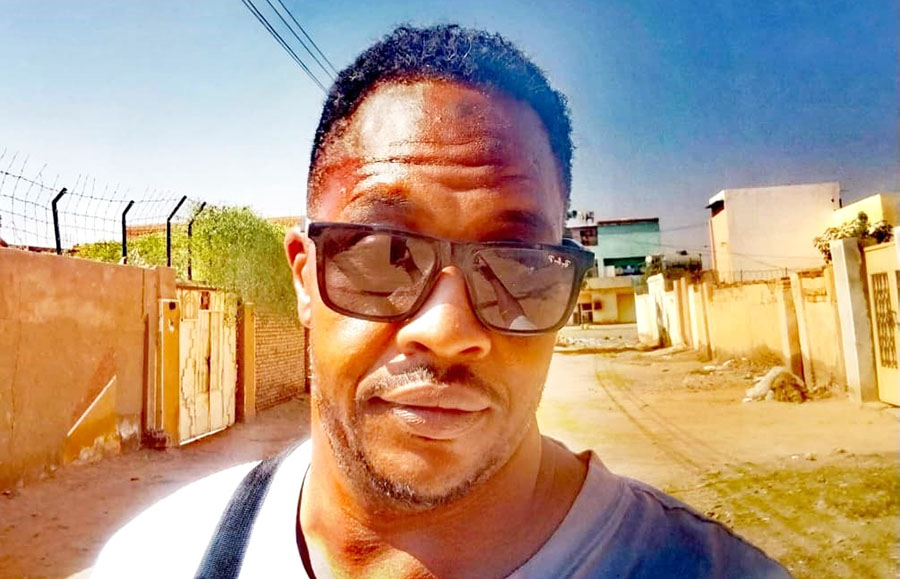
“Al ‘Russi’ Who Found War Breaking Out Over His Head at Khartoum Airport”
Khartoum – Moatinoon
When the young man, Nasser Ahmed Al-Basha, packed his bags, he left his luck behind in Saint Petersburg and departed Russia for his homeland, Sudan. He settled with his belongings at his family home in Block 20, Haj Yousif, in East Nile, east of the capital, Khartoum. But Nasser—nicknamed “the Russian”—never expected that the war of April 15 would erupt over his head while he was on duty in buildings adjacent to Khartoum Airport. He lived through terrifying moments on a day he described as horrific.
Speaking to Moatinoon, Al-Russi said:
“On the first day of the war, after I left the office and was out on the street, there was the sound of gunfire from all kinds of weapons, along with artillery and warplane shelling, and intense clashes coming from inside the airport. What made it even more frightening was that I was in contact with my colleagues via WhatsApp.”
Through surveillance cameras, they watched raids, assaults, and colleagues being threatened at gunpoint. It was a deeply terrifying scene, as if they were watching a Western TV series. At the time, while sitting inside a bus, Al-Russi wondered: “Could we be attacked and assaulted like what we’re seeing?” Thankfully, he says, “God was merciful,” and he survived that bloody day.
Nasser Ahmed, who studied airport engineering in Russia, added:
“I survived by a miracle and returned home safely. I wasn’t injured like others. On the second day, the Rapid Support Forces began attacking civilians and stealing luxury and modern vehicles. I have never seen anything like this in my life—not even in my imagination.”
Al-Russi continued recounting his story:
“I studied in Russia, and after finishing my studies, I traveled to the UAE in 2012 in search of work. Despite my efforts and my advanced qualifications in airport engineering, I failed to find a job. So I decided to return to Sudan in 2021. Despite the instability the country has experienced in recent years, I found a job with an airline company—not in my specialization as an engineer, but in security services within airport companies.”
He went on describing the day of horror:
“Strangely, my shift had ended the day before the war, on April 14. But I continued working to cover for a colleague who was absent due to family circumstances. Otherwise, I would have been at home on the day the clashes broke out.”
“I initially thought it was just an extension of the unrest in Khartoum caused by political tensions and protests. But when I reached my residence in Haj Yousif and saw the Rapid Support Forces militias, I was certain it was war. After that, we lived through tragic scenes—mass displacement, families and citizens fleeing داخل and outside Sudan. As for me and some others in high-risk jobs, we became trapped. We didn’t leave out of fear of the dangers on the roads, and we lived amid suffering and fearing until the army entered.”
