
Updated: 6 August 2026 16:10:50
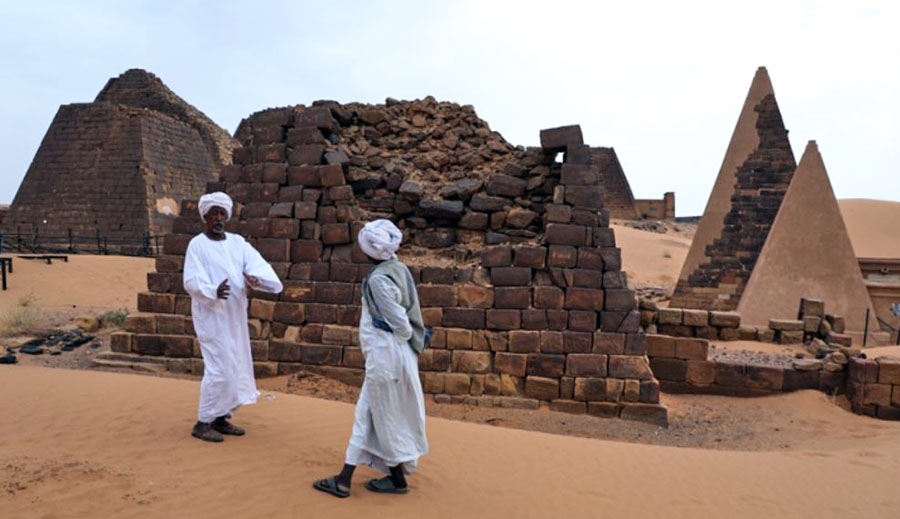
War and climate threaten the pyramids of Meroe in Sudan
Agencies
The ongoing war in Sudan threatens the integrity of the ancient Pyramids of Meroe, a UNESCO World Heritage Site known for its unique and angular architecture, as preservation efforts have come to a grinding halt.
Archaeologist Mahmoud Suleiman warned, “The site may face a disaster, and collapses are possible,” according to an Associated Press report.
Meroe, located about 200 kilometers (125 miles) north of the capital, Khartoum, includes more than 200 pyramids that were built between 800 BC and 350 AD as royal tombs for the rulers of the Kingdom of Kush.
In this context, Mustafa Ahmed, one of Meroe’s guards, said as he made his way through the sand dunes at the site: “The thickness of the sand has increased greatly on the pyramids and even inside the temples, and the grass has grown densely. The pyramids have deteriorated greatly and stones have begun to fall.”
For his part, Mohamed Mubarak, the Antiquities Inspector, added that the salt released from the accumulated sand had collected inside the funerary temples and led to the deterioration of the naturally fragile stones, exposing the ancient inscriptions to the risk of corrosion.
Suleiman said, "Climate change, the war that led to the dispersal of the workforce, and the difficulty of foreign missions continuing their work amid the security instability in the country, all of which contributed to the significant deterioration of the site."
The bloody conflict in Sudan, which broke out in April 2023, destroyed many historical sites and museums in the country.
UNESCO warned in April that cultural and historical sites were under increasing threat, with more than 100 cultural sites damaged and at least 22 museums looted or destroyed since the start of the war.
The ancient pyramids of Meroe have been standing tall in the heart of Nubia in northern Sudan for about two thousand years, a living monument built by the hands of the rulers of the great Kingdom of Kush.
Despite the inclusion of more than 200 pyramids in the region on the UNESCO World Heritage List, and their resistance to the encroachment of sand, the fluctuations of rain, and the ravages of time, none of them were spared the harm of destruction and neglect, as some of them turned into rubble and the heads of others were cut off2, starting from the dynamite explosions carried out by European adventurers hunting for treasure in the nineteenth century, all the way to the succession of two centuries of natural erosion factors.
Today, the site, which is a three-hour drive from the capital, Khartoum, is the most attractive heritage destination for visitors in Sudan. It was completely silent, interrupted only by the bellowing of a lone camel.
In 1834, the Italian adventurer Giuseppe Ferlini leveled the temple of Queen Amanishakhito to the ground and destroyed dozens of pyramids, transporting her precious jewels to Europe, where they adorn the museums of Berlin and Munich to this day. All that remains of that temple is a solid outer wall, which embodies a huge inscription of the Kushite queen standing majestically, standing with her weapons, trampling on the enemy’s prisoners.
