
Updated: 7 August 2026 16:19:07
A Torn Mural on the Eve of the Coup
Al-Asmai Bashari
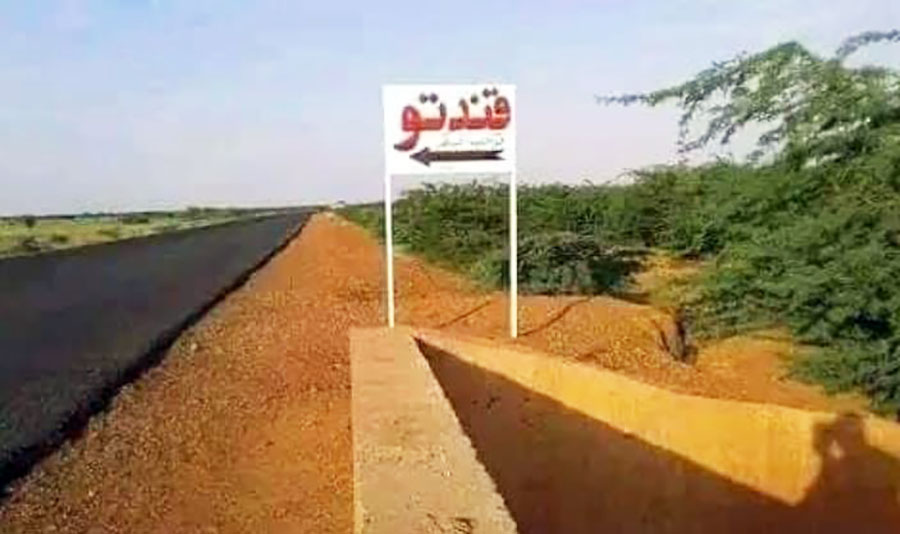
On a heavy evening in June 1989, my village of Qandatu, south of Shendi, seemed more tranquil than usual. It was as if the village, so accustomed to its quietude, couldnt hear the approaching footsteps.
Children filled the dusty squares, chasing a small ball, their laughter echoing between the houses, while the elders sat in the shade of trees, exchanging daily conversations: news of the crops, the markets, relatives, and then politics, which was no longer a distant news item broadcast on the radio, but something that seeped into their gatherings, their homes, and their friendships.
Khartoum was boiling that day, political parties were clashing, the streets were choked with disputes, and demonstrations erupting from some mosques against Sadiq al-Mahdis government were further inflaming the situation. But Qandatu, despite everything, seemed that night to be experiencing an ordinary evening. Only something mysterious in the air suggested that the ordinary was about to end. Not far from that scene, on the wall of a small youth club, hung a paper mural. Little did anyone know that, just a few hours later, it would become one of the most vivid images I have of those days. A large sheet of paper hung with simple nails, on which we wrote our news, opinions, and questions. Then, a single hand tore it down, before the coup, the following day, tore apart a much wider swathe of Sudanese life.
My story with that mural began almost a year earlier, when, like many of my generation, I became involved in public service through the Qandatu Youth Union. It was a voluntary, community-based organization we established to give young people a space for life outside the confines of direct politics—for sports, culture, seminars, social programs, and a simple sense that a village could achieve something for itself without waiting for anyone from Khartoum.
In 1988, I was the social affairs secretary for a training course headed by a member of the National Islamic Front, a young man who would later become a high-ranking officer in the intelligence service. Back then, names didnt hold the same weight in our minds as they would later. We didnt know that some of the faces we sat with around the same table would become part of the new state apparatus, and that some of those who had debated with us about small youth activities would find themselves, after the coup, in positions where even speaking out became a dangerous act.
For us, the Union was a welcoming home for young people, and we didnt see the need to ask each person about their political affiliation before inviting them to a meeting or participating in an activity. But politics had begun to seep into everything, like water leaking through a small crack in a wall and never stopping. Sensitivity grew toward the presence of the Islamist cadre at the head of the Union. Some in the local community felt that the Islamists expansion within civil society organizations was becoming too dominant, and that their continued leadership made cooperation between the Union and the local Peoples Council more difficult.
The pressure mounted until they were replaced by a more widely accepted, independent figure, and I moved to the position of Secretary-General of the Union. We didnt know then that what was happening within that small union was almost a carbon copy of what was happening throughout Sudan: a struggle for space, for influence, and for the definition of who had the right to speak on behalf of society and who had the right to shape its future.
The June 1989 elections came, and a new executive committee was formed, in which I retained the position of Secretary-General. We could have simply continued with the usual activities, but we decided to organize a cultural week, a week we envisioned as a space for encounter, not an arena for confrontation, and to prove to ourselves and to the youth that culture could, even if only temporarily, open a window in the wall of politics.
The days were filled with seminars, evenings, and social programs, and we published a daily wall newspaper we called "The Weeks Mural." I shared the responsibility of editing it with the Secretary of Cultural Affairs and Media. We would write, revise, and post what we wrote on the wall, and then sometimes stand in front of it to watch people read it. The mural was simple—papers, pens, and a limited space—but for us, it was something much bigger than its size. A small window through which the youth of the village look out at their issues and the issues of their country.
On the third day, we wrote a headline whose political message was unmistakable: “The Mosque Revolution… Destabilizing Sudan’s Security and Stability.” We objected to the exploitation of mosques in political conflict, fearing that places of worship would become tools for partisan mobilization, and that religion would fuel a conflict that would consume what little remained of the common ground between Sudanese people.
We didn’t write the headline to ignite a battle, but because we believed—perhaps naively—that the mural was a space for opinions, and that disagreement required no more than a written response or discussion at the next seminar. But the mural didn’t last long. One of the Islamists, the same man who would later become a high-ranking officer in the intelligence service, approached the mural. The scene was brief, requiring no speech, threat, or debate. He reached for the paper and tore it up.
I still remember the sound of the paper splitting under his hand; a short, sharp sound, as if something fragile within us had broken along with it. The mural hung from the nails, some fragments falling to the ground, while others remained suspended, dangling slightly in the air. I stood before it, gazing at the torn banner, and for the first time, I felt that it wasnt just a mural. Sudan itself seemed to me at that moment like that piece of paper; each side pulling a part of it in its direction, and the more the pulling, the more the fabric tore. We didnt know that the remaining time was so short, and that Khartoum, which seemed distant in the news, was preparing to change the entire face of the country. A few hours later, before dawn, the Sudanese awoke to the sound of the first announcement.
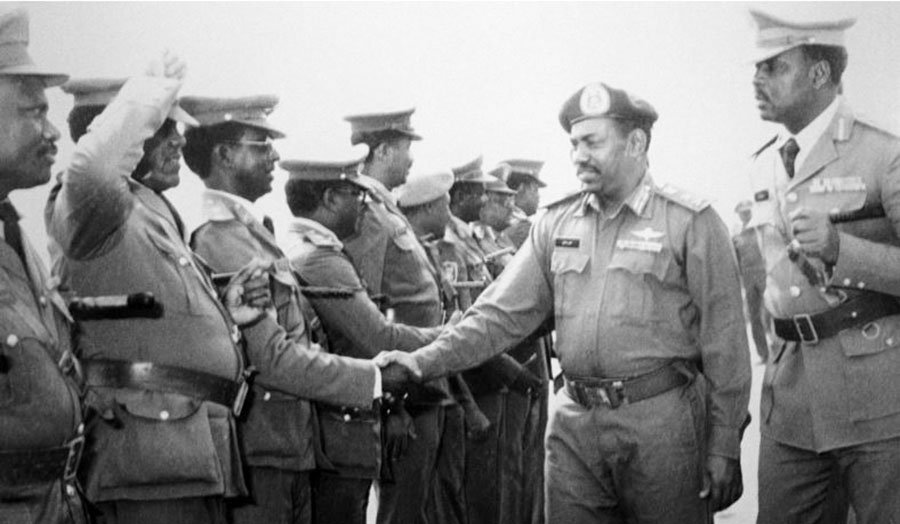
On June 30, 1989, the elected government of Sadiq al-Mahdi was overthrown in a military coup, and from that dawn, Sudan entered a new political era. The language changed, the institutions changed, the relationship between the state and society changed, and people quickly discovered that what could be said yesterday could today be a cause for fear.
The echoes of the coup reached Qandatu quickly, and the next day, my grandfather, Salman Awad al-Karim, "al-Sanjak," may God have mercy on him, demanded the cancellation of the remaining events of the cultural week. He was more perceptive of the danger than any of us. He believed the country had entered a new era, and that continuing cultural activities at that moment might be a risky gamble with unknown consequences. But he spoke with the logic of a man who had witnessed the shifting power structure, while I spoke with the logic of a young man who still believed culture could remain independent of power. I refused to cancel the program.
I told myself, at least, that a coup in Khartoum shouldnt shut down a club in Qandatu, that the young people who had gathered for cultural activities werent party to the conflict, and that the platform we had opened for dialogue shouldnt be closed simply because the government had changed. I held firm, perhaps unaware that I was clinging to something more than a cultural week; I was clinging to the idea that there was a small space that could remain outside the grip of politics. But reality was faster and harsher than our convictions. Fear began to seep into peoples hearts, their tone changed, and silent questions began to appear in their eyes before they were spoken aloud: What would happen? Who was watching? Who could be trusted? As the pressure mounted, the majority leaned towards cancellation.
The events were halted before they could conclude, the club doors were closed, and the lights of the cultural week were extinguished like a lone candle in a force it cannot resist. Then I received a direct threat because of my refusal to cancel the program and my insistence on continuing the cultural activity. Only then did I understand that the issue was no longer a disagreement over a program, a mural, or a seminar, and that the country that awoke on June 30th was not the same country that slept on the 29th.
Years passed, but memory never closed that door. Whenever I return to those days, the image of the mural hanging on the wall returns to me, then the hand that reached for it, then the sound of the paper tearing, then the small scraps that fell to the floor.
Sometimes I think that what happened in Qandatu was a very small version of Sudans history in the following decades: politics entering society through the narrowest of doors, then disagreements turning into alignments, alignments into rivalries, rivalries into fear, and then fear finally closing the spaces where people used to meet.
The mural was, in reality, nothing more than a piece of paper, but that paper held the meaning of a place that allowed us to disagree. When it was torn, not just one opinion was torn away, but the very idea that disagreement could coexist in the same space as another was torn away. Perhaps thats why that incident has remained etched in my memory all these years; because it no longer belonged solely to Qandatu, its youth union, or those young people who sat down one evening to write a wall newspaper. Rather, it became, for me, an early image of the Sudan we would come to know later: a homeland where the distance between people widens as the space for dialogue shrinks, where culture is the first to pay the price of polarization, and where civil society constantly finds itself forced to justify its right to exist. Today, decades after that night, and after another war that consumed cities and homes and displaced millions, that torn mural seems more present to me than ever.
For war did not only destroy buildings; It also destroyed many of the spaces where people used to meet, closed schools, theaters, clubs, and cultural centers, and drove young people into the streets and displacement and refugee camps, making fear a part of daily life. Therefore, I dont recount the story of the Qandatu mural as a personal anecdote about an old political dispute, but rather as a reminder that a society that loses its civic spaces becomes more vulnerable to violence and polarization.
Rebuilding Sudan will not begin with concrete alone, nor with the roads, bridges, and institutions destroyed by the war, but also with rebuilding those small spaces where people can sit together, talk, disagree, and write whatever they want on their walls without fear of having their paper torn down or their voice silenced.
Perhaps thats why I still remember the mural as if it hadnt been torn down thirty-seven years ago. I remember it because it was small, like our dreams back then, but it carried something larger than its size; it said that words have a place, that young people have a right to create their own space, and that culture can be a bridge when politics becomes a wall. But the wall tore, the paper fell, the lights of the cultural week went out, and Sudan went on to thirty years of rule that reshaped the state and society, then to a revolution, then to a new war, as if the country had been running after that first scrap of paper that fell from the mural ever since that evening, never to find it.
Perhaps the lesson we havent yet grasped is that a nation doesnt begin when people agree, but rather when they learn to disagree without tearing the paper from each others hands. In a country exhausted by wars, coups, and polarization, we dont just need to silence the guns; we need to re-hang the murals; to reopen clubs, schools, theaters, and cultural centers, to revive grassroots initiatives, and to give young men and women their right to shape the public sphere. We need walls that accommodate all opinions, not walls that separate Sudanese people from one another.
And perhaps, when we re-hang the first mural after all this devastation, we should remember well that old piece of paper in Qandatu; The paper that a man tore up one evening in June 1989, and we did not know at the time that the sound of it being torn was, in a way, the first sound of an entire nation being torn apart.

