
Updated: 16 September 2026 13:47:19
Gold Mine Collapses in Sudan: A Continuing Deadly Pattern
moatinoon
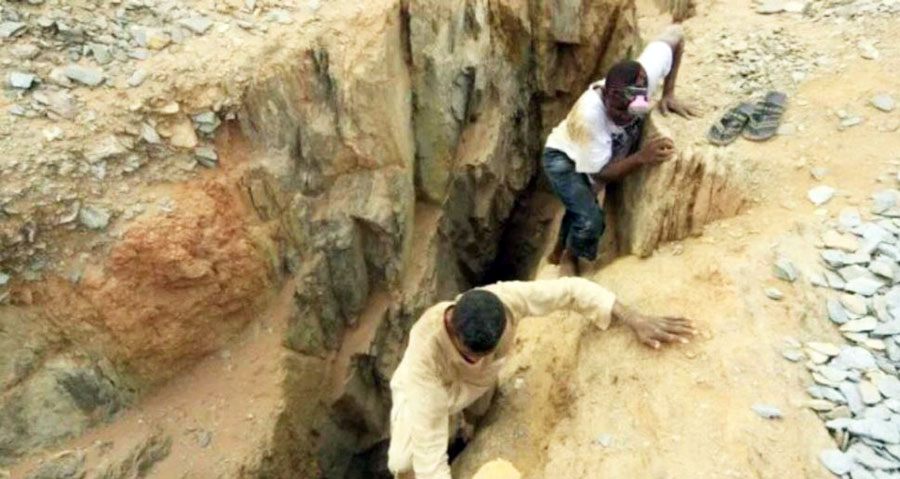
Gold mine collapses have continued to occur in Sudan throughout 2026, leaving dozens dead and injured. This trend persists as reliance on artisanal mining grows—serving as a vital income source amidst an economy battered by war, a decline in agriculture, and the plummeting value of the local currency.
Agence France-Presse (AFP) reported that at least 60 people were killed when a gold mine collapsed in Sudan on Wednesday, September 16, 2026.
While gold remains a crucial source of foreign currency for the country, miners pay a heavy price for working in environments that observers describe—in many locations—as lacking even the most basic safety standards.
One of the deadliest incidents occurred last January when sections of the "Um Faqroun" gold mine in South Kordofan State collapsed. According to the Sudanese Mineral Resources Company, the collapse killed 13 miners and injured six others. The incident took place within five abandoned shafts, highlighting a key aspect of the problem: the continued operation of sites that had previously been closed or deemed unsafe.
In April, another collapse occurred in the Kiliti area of the Ganab and Awlib locality in Red Sea State. The accident, which took place in an informal mine, resulted in six deaths, according to local sources. The incident once again brought to the fore the dangers facing thousands of artisanal miners, many of whom work at sites lacking engineering oversight and basic safety protections.
In July, an even deadlier incident occurred in the Northern State when the "Mohammed Tawfiq" mine—located in the Samna area of the Wadi Halfa locality, near the Egyptian border—collapsed while miners were inside. The Sudanese Mineral Resources Company announced the deaths of 15 miners and the injury of another. Reports indicated that the mine had previously been closed due to safety concerns, but workers had returned to the site to resume gold extraction.
Combining these three documented incidents brings the death toll to at least 34 people—excluding victims of other potential accidents in remote locations that went unreported to the media or authorities. The January incident alone resulted in 12 injuries according to initial reports, with the fate of several workers remaining unknown in the immediate aftermath of the collapse.
These figures take on added significance given the nature of Sudans gold sector. Artisanal and small-scale mining accounts for the bulk of gold extraction operations, with thousands of sites scattered across vast areas of the country. According to the Associated Press, this type of mining often operates outside regulatory frameworks and lacks adequate safety standards, making shaft and tunnel collapses a recurring hazard for workers.
The risks extend beyond collapses; artisanal miners also handle toxic substances—such as mercury, used to separate gold from ore—often without proper protective equipment. Press reports indicate that small-scale mining operations are widespread across Sudan, and that many workers entered the sector after the war shut off other avenues for earning a living, particularly in agriculture and trade. Official data cited by the Associated Press indicates that Sudan produced approximately 70 tons of gold in 2025—up from 64 tons in 2024—generating estimated revenues of 1.8 billion. This occurs in a country that lost a significant portion of its oil resources following the secession of South Sudan, making gold a crucial source of foreign currency and income in recent years.
However, the economic importance of gold coincides with a highly complex security and political landscape. Since the outbreak of war in April 2023, mining has become part of a "war economy," with extraction and trade operations spreading across areas under varying control, alongside growing reports of gold being smuggled outside official channels. According to an Associated Press report citing experts, the ongoing conflict and weakened state institutions have fueled the expansion of unregulated mining activities and undermined the authorities ability to enforce safety standards.
In this context, recurring mine collapses appear to be more than just isolated workplace accidents; they expose the fragility of a sector upon which thousands of Sudanese rely to support their families, even as the state remains dependent on the resulting revenue. Closing a dangerous mine does not necessarily halt operations—as demonstrated by the Wadi Halfa incident, where workers returned to a site that had been shut down due to safety risks.
Determining a definitive national casualty count for mine collapses in 2026 is difficult due to the vast geographical spread of mining areas, limited access to certain conflict-affected zones, and the inconsistent publication of official data. Therefore, the figure of 34 fatalities represents the toll from incidents that could be verified through available sources, and not necessarily the total number of victims.
