
Updated: 20 September 2026 19:27:23
Protests Erupt in Gedaref Over Rising Prices
Moatinoon
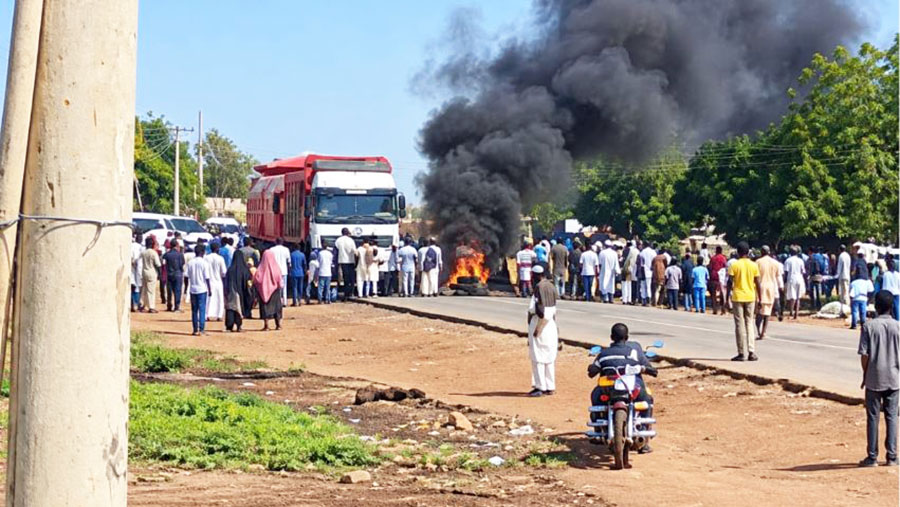
Residents of Al-Tadamun neighborhood in Gedaref took to the streets on Sunday to protest soaring commodity prices and deteriorating living conditions, as public frustration grows over mounting economic pressures caused by the sharp depreciation of the Sudanese pound and rising living costs.
According to information circulating locally, protesters took to the main road near the girls’ school in Al-Tadamun at around 9 a.m. and blocked the road for a period in protest against rising prices and worsening economic and living conditions. Demonstrators called for urgent measures to contain price increases and ease the burden on households.
The protests in Gedaref followed demonstrations and public protests in Omdurman on Friday over deteriorating living conditions and rising prices of goods and services, amid growing calls for action to address the deepening economic crisis.
Other Sudanese cities and areas have also witnessed protests and growing public complaints in recent weeks over rising prices and declining purchasing power, as markets struggle with severe volatility in the exchange rate of the Sudanese pound.
The Sudanese currency has suffered a sharp depreciation against foreign currencies in recent weeks. The US dollar traded above 8,000 Sudanese pounds on the parallel market during September before temporarily falling to around 7,600 pounds late last week, amid extreme volatility in the foreign-exchange market. The fluctuations have triggered another wave of price increases for basic commodities and prompted some traders to stop selling or close their shops because they cannot determine stable prices for their goods.
Local economic reports said the collapse of the pound has forced large numbers of shops to close in several cities. Around three-quarters of shops in Ed Dueim, White Nile State, have reportedly closed, while a large proportion of wholesale businesses in Omdurman have also shut down as traders struggle to reprice goods amid rapidly changing exchange rates.
The currency crisis has directly affected food prices. The price of a 50-kilogram sack of sugar in Omdurman, according to local reports, rose from about 350,000 pounds to 420,000 pounds before temporarily declining as the Sudanese pound recovered slightly late last week.
Traders say the problem is no longer limited to higher prices but has evolved into widespread uncertainty and market stagnation. Some traders have stopped selling altogether because they fear that the cost of replacing their stock will rise before they can replenish it.
The developments come as Sudan’s economy continues to suffer from the impact of more than three years of war, including declining production, disrupted supply chains, higher transportation and import costs, and a sharp deterioration in household purchasing power.
On September 18, reports indicated that large numbers of shops in markets in Khartoum and Wad Madani had closed amid further depreciation of the Sudanese pound, with the US dollar trading above 8,200 pounds in some transactions. The depreciation has directly pushed up the prices of basic commodities.
The developments are placing additional pressure on Sudanese households already struggling with delayed salaries and rising costs of food, medicine and transportation, while incomes and savings continue to lose value amid currency depreciation and inflation.
The latest protests in Gedaref, Omdurman and other cities indicate that the economic crisis is increasingly spilling over from markets into the streets, as public demands grow for urgent measures to contain inflation, restore purchasing power and address instability in the currency and commodity markets.
The protests come as authorities have announced measures to address rising prices, including the establishment of fixed and mobile sales points intended to make some commodities available at lower prices. The government has also been considering additional measures to curb foreign-exchange volatility and crack down on currency speculation.
