Updated: 26 September 2026 11:17:01
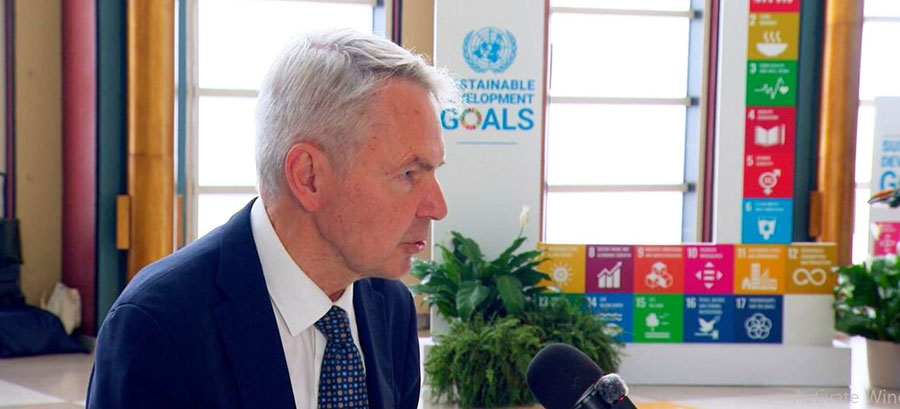
Haavisto: Extensive Diplomatic Efforts to End the War; Both Sides Counting on Victory
Maotinoon Follow Up | Source: UN News
Pekka Haavisto, the Personal Envoy of the UN Secretary-General for Sudan, stated that extensive diplomatic efforts are currently underway to reach a peaceful resolution to the war. However, he noted that both parties to the conflict are still banking on military gains to strengthen their positions prior to any negotiations.
In an interview with UN News at the UN Headquarters in New York, Haavisto explained that the General Assembly’s High-Level Week saw intense diplomatic activity regarding Sudan. This included meetings of the "Quad" (comprising the United States, the UAE, Saudi Arabia, and Egypt) and the "Quint" (which also includes the African Union, IGAD, the League of Arab States, the European Union, and the United Nations).
The UN envoy expressed a degree of optimism, citing what he described as small confidence-building steps. These include the establishment of mechanisms by both conflict parties to discuss the issue of detained civilians, as well as the potential for prisoner exchanges and the release of civilians.
He noted that the situation is further complicated by the fact that both warring parties are coalitions comprising multiple factions and military commanders; consequently, reaching a political settlement requires broad diplomatic efforts that engage all influential forces.
Haavisto warned against the increasing use of drones targeting civilian sites, aid convoys, schools, and hospitals, and called for a halt to the flow of weapons and drones into Sudan. He also noted that, according to UN personnel, approximately 99% of unexploded ordnance in Khartoum still requires removal.
He emphasized the importance of regional cooperation to prevent the war from spilling over into neighboring countries—given the ongoing influx of refugees—and underscored the necessity of including women, youth, and civil society in the political process.
In a message to the Sudanese people, Haavisto said, "You are not alone," stressing that the path to peace requires ending the war and addressing its impact on the countrys social fabric. He noted that while the warring parties are not yet ready to sit at the same negotiating table, they are open to the shuttle diplomacy led by the United Nations.
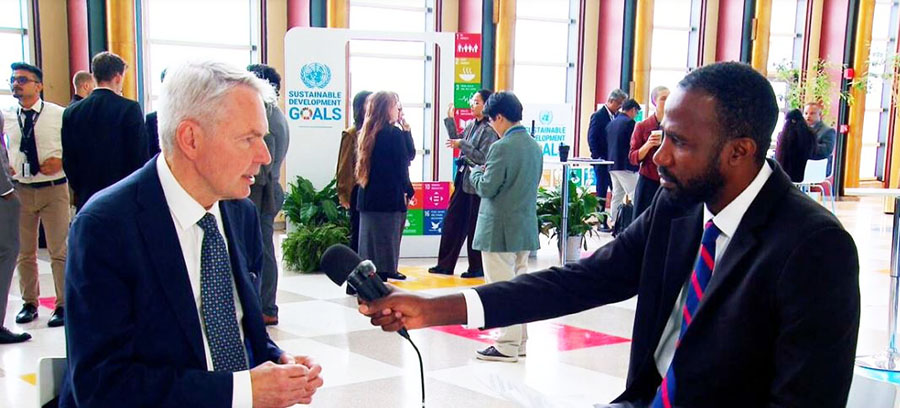
UN News: Mr. Pekka Haavisto, thank you very much for taking the time to speak with us. To begin, could you tell us why you are here in New York?
Pekka Haavisto: I am here coinciding with the General Assembly meetings. We have held several meetings regarding Sudan, including a very important meeting yesterday with the Quartet and Quintet groups. The Quartet consists, of course, of the United States, the United Arab Emirates, Saudi Arabia, and Egypt—key nations currently working together to secure a humanitarian truce in Sudan.
The Quintet comprises the African Union, the Intergovernmental Authority on Development (IGAD), the League of Arab States, the European Union, and the United Nations, all working together for the sake of Sudan. I always tell Sudanese people who complain that this conflict is forgotten that I know of no other conflict where such a wide range of countries and international institutions are cooperating to find a peaceful solution.
UN News: How would you describe these discussions?
Pekka Haavisto: They have been diverse, as is always the case regarding Sudan. There are many stakeholders. We met with government representatives, civil society members, and, of course, neighboring and regional countries. On the other hand, there are also proxy actors involved in this war, and so forth.
Therefore, all these concerned parties are essential to paving the way for a peaceful solution in Sudan. I feel somewhat optimistic right now, because never before have diplomatic efforts of this magnitude been undertaken to find a peaceful solution.
However, on the other hand, I see that the parties within Sudan are still seeking military victories and trying to strengthen their military positions in preparation for negotiations, and so on. That is why the conflict continues.
UN News: Why are you optimistic? And what is this optimism based on?
Pekka Haavisto: I have just returned from Khartoum. One positive step is our UN initiative to build upon certain confidence-building measures. For instance, we discussed the issue of civilian detainees—as well as the possibility of prisoner exchanges and the release of civilian detainees—with both sides: the camp of General Abdel Fattah al-Burhan and that of General Mohamed Hamdan Dagalo, known as Hemedti.
Both sides have now established a mechanism to discuss this matter with us. These may be small steps, but at the very least, they signify movement.
UN News: You mentioned that both sides still seem convinced that military gains are achievable. What is preventing them from realizing that a negotiated settlement is essential?
Pekka Haavisto: Perhaps one element of this complex situation is that both sides—whether General al-Burhan’s camp or General Hemedti’s—are coalitions comprising multiple stakeholders. Reaching an agreement on issues that lead to peace requires not only the consent of the generals but also the approval of the various actors within these coalitions.
There are figures such as Minni Arko Minawi and Gibril Ibrahim on the government side—that is, al-Burhan’s side—and others like Abdelaziz al-Hilu on the opposing side, among others. These are highly experienced military leaders who command their own distinct military formations and forces. Therefore, the entire matter requires a great deal of diplomacy to piece together this puzzle so that everyone moves in the same direction.
UN News: On the ground, you have previously highlighted the increasing use of drones in the Sudan conflict. How is this changing the nature of the war, particularly regarding the risks to civilians and civilian infrastructure?
Pekka Haavisto: The use of drones is, of course, a highly destructive factor in this war. Both sides have access to modern drone technology, and these drones are being used against civilian targets, humanitarian aid convoys, schools, hospitals, and more.
This naturally violates international law, but it also turns civilians into victims of the war. I have said that while there are many civil wars in the world, this one is, in many respects, a war against civilians; women, children, and civilians are frequently targets in this conflict.
Therefore, every effort must be made to halt the flow of weapons into Sudan—and specifically, the flow of drones.
During my last visit to Khartoum, I met with UN mine-action personnel from the UN Mine Action Service (UNMAS). They reported that only about one percent of unexploded ordnance in Khartoum has been cleared, leaving 99 percent still present. This illustrates the immense task that lies ahead regarding unexploded ordnance.
UN News: You have engaged in efforts with Egypt and other countries in the region. How important is regional coordination in preventing the conflict in Sudan from escalating into a regional crisis?
Pekka Haavisto: Regional cooperation is crucial. We are already seeing the war spill over into Ethiopia, Chad, and elsewhere. Countries in the region and neighboring states can do a great deal to maintain peace and support peaceful solutions.
That is why we have been traveling extensively to neighboring countries as well. I believe the message coming from them is that they, too, are bearing a heavy burden by hosting refugees—particularly as new refugees continue to arrive across the Chadian border due to the fighting.
I believe it is in everyones interest to halt the cross-border spread of the war and to help address the refugee crisis. The only way forward, of course, is to reach a peaceful solution.
UN News: Mr. Haavisto, you have emphasized the importance of a political process that is inclusive, Sudanese-led, and Sudanese-owned. How can women, civil society, political forces, and the Sudanese diaspora play a meaningful role in shaping the countrys future?
Pekka Haavisto: As part of the Quintet, we have met with political parties and coalitions, but we have always made a special effort to meet with women’s groups and youth groups.
Young people played a crucial role during the war—establishing emergency response units, assisting local communities, and more. Many of them demonstrated immense courage within the country.
Whenever we traveled anywhere, we made a concerted effort to meet these young men and women and ensure their voices were heard in the peace process. I believe this must continue.
As we look toward the hoped-for transitional period and the eventual establishment of a lasting democratic system in Sudan, it is vital that participation is not limited to political parties but also includes women’s and youth groups.
UN News: On the humanitarian front, Sudan is facing what has been described as the world’s largest hunger and displacement crisis. Around 20 million people are facing acute hunger, and 14 million have been displaced. Many Sudanese feel the international community is failing to help them. What is your message to the Sudanese people and to the parties to the conflict?
Pekka Haavisto: My message to the Sudanese people is, of course: You are not alone. When I look at the humanitarian aid the UN is providing to the country, I see that the UN is doing its utmost; however, the fighting sometimes prevents aid from reaching those who need it. Furthermore, direct attacks on humanitarian convoys and aid workers continue to occur. Humanitarian work in Sudan is extremely dangerous.
As for the parties to the conflict, what is required is not merely an end to the war, but also support for civilians in building a better future. We met with women’s and youth groups, and many of them say they cannot forgive what happened. This war has shattered the country’s social fabric, and the road to peace will be long; it requires acknowledging what occurred and finding ways to coexist with other Sudanese people who may have committed crimes or supported parties that did.
This also represents a profound spiritual journey that lies ahead for the Sudanese people.
UN News: This is not your first time dealing with the situation in Sudan; you have previously held other positions that involved working on Sudan-related issues. How has that experience helped you better understand the situation in the country and the challenges facing the Sudanese people?
Pekka Haavisto: When I was involved in the Darfur peace process—twenty years ago or more—I met many actors who remain active today, such as Dr. Gibril Ibrahim, Minni Minnawi, Abdelwahid Mohamed Nour, and others who were part of the peace talks in Abuja at the time.
However, this war has naturally become much more complex. There are more actors and more interlocutors involved, and the role of the region and neighboring states—as well as the dimension of parties fueling a proxy war—is constantly growing.
That is why it is crucial to work not only with the Sudanese people but also with countries in the region to find a peaceful solution.
UN News: Do you have any final words?
Pekka Haavisto: Well, everyone asks me this question: Am I optimistic or pessimistic? I always say that even the smallest steps toward peace are positive at this stage. The parties are not yet ready to sit at the same table, but they do accept a certain type of shuttle diplomacy conducted by the United Nations. That is what we are currently trying to do.

