
Updated: 27 September 2026 15:07:00
Ethiopia: From Ethnic Conflict to a Regional Water War
By: Al-Asmai Bashri
The Chief of Staff of the Ethiopian National Defense Force, Field Marshal Berhanu Jula, accused Egypt, Sudan, and other parties of providing support to anti-Addis Ababa groups, arguing that the Tigray Peoples Liberation Front (TPLF) and Eritrea do not constitute an influential force on their own without external backing.
Jula stated in remarks to the Ethiopian military media platform, reported by the Saudi Al Arabiya channel, that external forces are—according to his assessment—providing support and equipment to a new coalition comprising armed and political groups, as part of what he described as attempts to affect Ethiopia’s stability.
The Ethiopian Army Chief of Staff added that, in his evaluation, the TPLF and Eritrea do not represent an influential force independently unless they receive support from Egypt, Sudan, and other parties outside the region.
The statements by the Chief of Staff of the Ethiopian National Defense Force, Field Marshal Berhanu Jula, come at an extremely sensitive moment in the Horn of Africa. Ethiopia is not only facing a resurgence of conflict in Tigray, but also finds itself confronted with an intertwined network of disputes stretching from Eritrea to Sudan and the Red Sea, intersecting with the Grand Ethiopian Renaissance Dam (GERD) issue and Egypts water interests. Most importantly, the Ethiopian accusation against Egypt and Sudan of providing support to Addis Ababas opponents—even if it requires independent evidence to prove—reveals the extent to which Ethiopian domestic politics has become linked to regional calculations.
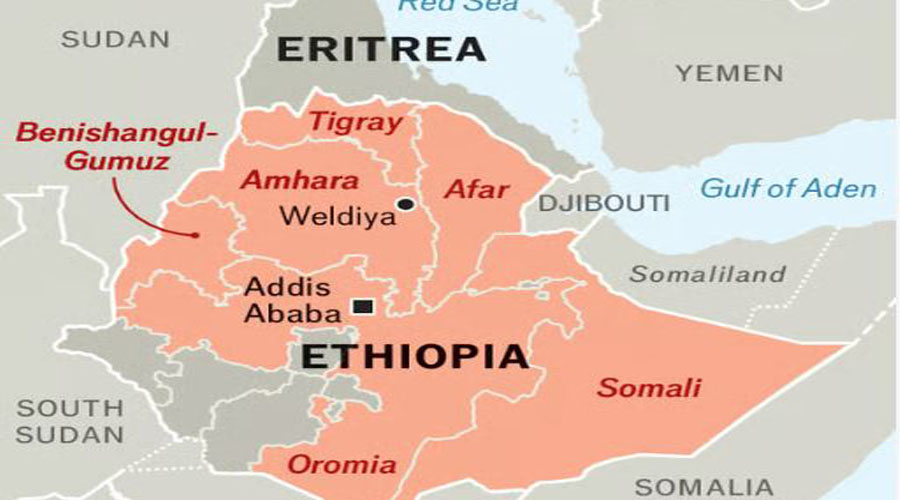
What makes these statements even more dangerous is their timing. In September 2026, a new Ethiopian coalition was formed comprising seven armed and political groups, including the TPLF, the Amhara Fano militia, and the Oromo Liberation Army (OLA), alongside groups from other regions. This coalition brings together forces that were, until recently, fighting one another, but are now aligned in opposition to Abiy Ahmed’s government. Furthermore, fighting has flared up again in Tigray and spread to the Afar and Amhara regions, prompting the African Union to warn that these new developments threaten to undermine the gains achieved following the 2022 Pretoria Agreement.
In this context, Jula’s talk of "external enemies" can be read as more than just a security accusation. The Ethiopian government is facing a complex internal equation: Tigray, whose wounds from the previous war have not yet healed; Amhara, where Fano transformed from an ally of federal forces into an armed adversary; Oromia, where conflict with armed groups continues; in addition to mounting tension with Eritrea. Consequently, in security rhetoric, it becomes easy to link these crises together and frame them within a single regional project targeting the Ethiopian state. However, this interpretation remains the Ethiopian governments stance, especially since Eritrea has repeatedly denied similar accusations, and officials from Tigray have likewise denied receiving military or logistical support from neighboring countries.
In fact, the relationship between Addis Ababa and Asmara represents one of the main keys to understanding current developments. Following the historic reconciliation between Ethiopia and Eritrea in 2018, the two countries later turned back into adversaries—particularly after the Tigray War and the Pretoria Agreement, and subsequently due to Ethiopia’s ambitions to secure access to the Red Sea. This file has made Eritrea a central party in Ethiopian security calculations and reshaped regional alliances.
From here, Sudan enters the equation almost inevitably. Sudan is not merely a neighboring state to Ethiopia; it is the nation situated directly between the Ethiopian conflict and its extensions into Northeast Africa, as well as the country practically most affected by any instability along the Ethiopian border. The border between the two countries is not just a geographic boundary, but a space where the Al-Fashaga issue, refugee movements, trade and weapons networks, the Sudanese war, and Eritrean and Ethiopian influence all intersect.
Therefore, accusing Sudan of supporting Addis Ababa’s opponents carries a strategic significance that goes beyond proving the allegation itself. If a conviction takes root within the Ethiopian military establishment that Sudan has become part of a pressure network against Ethiopia, the shared border could transform into an even more sensitive space, especially given the ongoing war in Sudan, which has made the border area part of a broader regional conflict. Recent analyses indicate contacts and intersections between Ethiopian opposition factions and Sudanese and Eritrean parties, while the nature and extent of actual military support remain a matter of dispute.
However, the most dangerous aspect of the current landscape is the shift of these tensions from geopolitics to the waters of the Nile.
The conflict surrounding the Renaissance Dam is no longer an isolated technical file separate from regional security. The dam has been completed and entered operational status following its official inauguration in September 2025. Meanwhile, the dispute between Ethiopia, Egypt, and Sudan over operational rules and mechanisms for dealing with drought years persists without a binding and comprehensive agreement. A recent academic study indicates that negotiations have remained stalled and that issues related to operation and water management during drought periods have not been resolved through a binding accord.
For Ethiopia, the GERD represents a symbol of sovereignty, development, and electricity generation, with Addis Ababa treating its right to utilize its water resources as an intrinsic component of its sovereignty. Egypt, on the other hand, views the Nile as a vital lifeline in a severely water-scarce nation, and renewed its rejection in September 2026 of any arrangements that allow unilateral control over river flows, according to Egyptian media.
Sudan finds itself in a more complex position. The dam can offer benefits regarding the regulation of Nile flows, reducing flood risks, and generating electricity; however, at the same time, Sudan requires guarantees regarding dam safety, data sharing, and operational rules—especially since the Roseires Dam is located a relatively short distance downstream from the GERD. Therefore, Sudanese interests cannot be reduced to a complete alignment with either Cairo or Addis Ababa; direct Sudanese interests necessitate joint management of risks and benefits.
Here lies the paradox: the more the political and military conflict inside Ethiopia escalates, the harder it becomes to separate the Nile issue from Ethiopian national security. If Addis Ababa feels encircled by Tigray, Eritrea, Sudan, and Egypt, it may become increasingly sensitive to any Egyptian or Sudanese maneuver, viewing water cooperation through a security lens rather than a purely technical one. Conversely, as Ethiopian rhetoric regarding sovereignty over the Nile intensifies, Egyptian and Sudanese concerns over the absence of binding operational rules grow proportionately.
This is the real danger: not necessarily that an internal Ethiopian war will directly lead to a water war, but rather that the water crisis becomes a core component of a multi-front regional conflict.
The Horn of Africa is already experiencing intense competition among regional and international powers, spanning from the Red Sea to Sudan, Somalia, Ethiopia, and Eritrea. Within this space, considerations of ports, trade, maritime security, energy, and political influence compete alongside the war in Sudan. Furthermore, Ethiopias push to secure maritime access has rearranged its relations with Eritrea, Somalia, Egypt, and other nations, integrating the Red Sea firmly into Ethiopian strategic calculations.
Therefore, the most dangerous scenario is not merely a return to war in Tigray, nor a fresh wave of tension between Ethiopia and Eritrea, nor even the continuation of the dispute over the Renaissance Dam—it is the entanglement of all these crises, where each issue serves as fuel for the next.
A new Ethiopian war could increase pressure on Sudan, the Sudanese war could heighten Ethiopias border anxieties, Ethiopian-Egyptian tensions could spill over onto the Nile waters, and the struggle over the Red Sea could reshape the alliances underpinning all these files.
From this perspective, Berhanu Julas statements serve as an important indicator of the security mindset within the Ethiopian state, even prior to substantiating the accusations contained therein. They convey, indirectly, that Addis Ababa no longer views its internal conflict as a purely Ethiopian affair, but rather as part of a wider confrontation over influence, resources, borders, water, and maritime access.
For this reason, protecting the security of the Nile does not begin with escalation, but rather by detaching water from the logic of military alliances. Sudan, Egypt, and Ethiopia—no matter the magnitude of their differences—cannot alter geography: Ethiopia is the primary upstream state for the Blue Nile, Sudan lies at the heart of its flow, and Egypt relies on it overwhelmingly. This reality renders zero-sum conflict unsustainable and makes cooperation on data exchange, drought-period operations, and the safety of water infrastructure all the more urgent.
At a moment when Ethiopia is heading toward renewed internal conflict, Sudan is living through open war, and sensitivities around the Red Sea are heightened, the waters of the Nile become more than a natural resource; they become a test of the regions ability to prevent domestic crises from spiraling into a comprehensive regional war. The most dangerous outcome of all would be for water to enter the calculations of warfare, when it ought to remain one of the few spaces forcing all parties to seek a formula for coexistence.
Ultimately, the future of the Ethiopian conflict will not be decided within Ethiopias borders alone. According to African Union reports, the wider the circle of conflict expands across Tigray, Eritrea, Amhara, and Oromia, the greater the likelihood that its fallout will spill into Sudan and the Red Sea, taking the Nile issue with it into further complexity. As for the Renaissance Dam—originally envisioned as a project for energy and development—it has already become an integral part of the regional security architecture. If water management is not decoupled from the logic of military polarization, the Nile crisis could transform from a protracted diplomatic dispute into one of the most perilous security files in the Horn of Africa.
