
Updated: 1 October 2026 15:38:08
Baraka Sakin: The Question of the Writing Project Between the ``Great Country`` and Exile

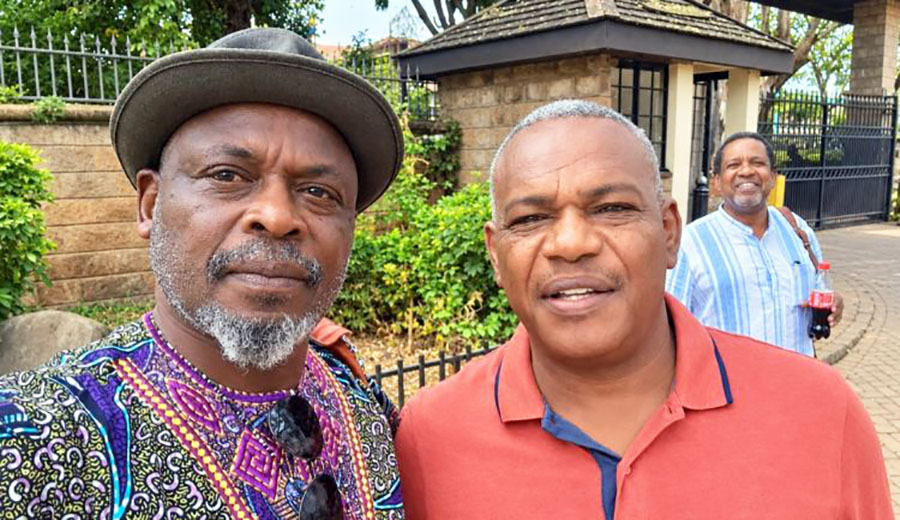
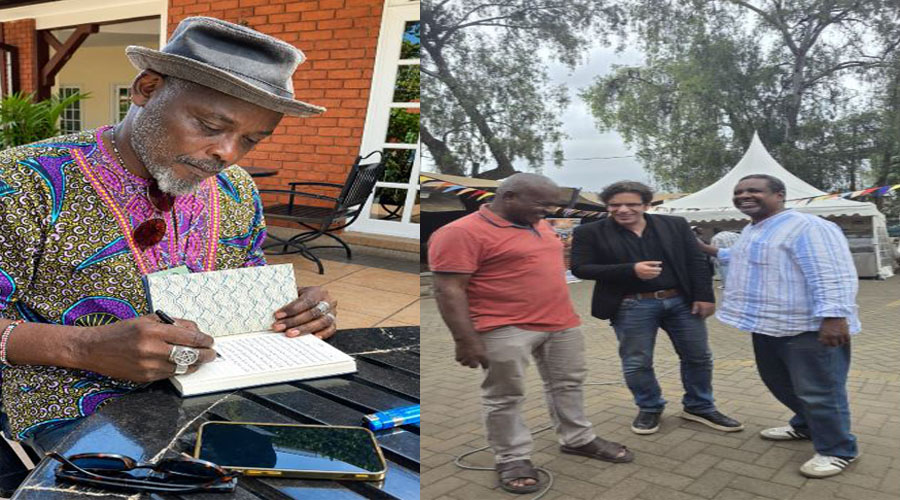
I was extremely fortunate to be among the audience during the final two days of the Kondo Literary Festival in Nairobi, which was held under the theme “The Sea, Writing, and Silence.” Hosted by the prestigious Kenyan Cultural Centre at the University of Nairobi, the festival saw the participation of a large number of writers, authors, and translators from Africa, Latin America, and Asia. The festival spanned a book fair, book-signing events, and public panel discussions with guest speakers, alongside music and heritage performances—a scene in which literature appeared less isolated from life and more closely tied to the questions circulating across continents, languages, and memory.
Sudan was present in this scene through the participation of Dar Al-Rayyes for Printing and Publishing, and the novelist Abdelaziz Baraka Sakin, whose recent novels—including Samhani—enjoyed clear interest from the festivals audience. This was in addition to the participation of the well-known critic, translator, and academic Dr. Ahmed El-Sadiq Berier, who moderated and translated several panel sessions.
However, Baraka Sakin’s presence in Nairobi was not, to me, merely a passing literary occasion. The festival seemed like an opportunity to re-examine an old yet recurring question regarding the writers relationship with the places that shaped their early experience, and what happens to the text when the distance grows between the novelist and the world they used to write about.
Following his final departure from Sudan and his settlement in Europe, Baraka Sakin’s relationship with the worlds that formed his first novelistic experiences appears to have transformed. Those worlds he wrote about in A Woman from Kampo Kadis, The Windmill Trilogy, The Jungo, and others were not merely a spatial backdrop for the novel; they were the very fabric of the narrative itself: the lives of ordinary people, their bodies, their modest dreams, their complex relationships, their dialects, their fears, and their fates intersecting with poverty, the margins, violence, authority, love, and loss.
In those works, Baraka Sakin was close to the characters he wrote about—not only in terms of geographical proximity, but in the sense of a sensory and social knowledge of that world. He knew how a character moved within a space, how they spoke, how they viewed themselves and others, and how language produced its own life inside the novel. Because of this, his early works acquired a tone that led many readers to view them as a rare attempt to open the Sudanese novel to social worlds that had long remained outside the center of the narrative.
Yet, something changed.
In his recent works, Baraka Sakin moved more distinctly toward historical fiction, culminating in Souk Al-Nassir (The Conquest Market). Here, a question arises—not out of a desire to judge the writer or demand that he remain captive to his initial worlds, but out of an attempt to understand the shift itself: Can writing history fictionally serve, for the novelist, as an alternative or compensation for writing lived experience and the daily reality he was once close to? Or does the transition to history represent an independent aesthetic and intellectual shift, unrelated to the distance that emerged between the writer and the Sudanese worlds he wrote about for so long?
This question was a central theme in the panel discussion organized by the Sudanese Story Club, following a first session organized by the Nubian Gallery for Sudanese Visual Artists, and a third session held on the sidelines of the Nairobi Literary Festival.
Baraka Sakin’s answer came cleverly—as is his habit when handling embarrassing questions and rearranging them within his own logic—yet, for several critics and observers of his literary project, it was not entirely convincing.
From what can be gathered from his response, Baraka Sakin believes that there are two parallel aesthetic projects in his novelistic journey. The first can be described as the project of the "Great Country," with its distinct features, styles, language, worlds, and characters—a project primarily tied to Sudan, its societies, and its social and cultural margins. The second is what might be called the "exile novel" (or diaspora novel), which relies more heavily on history and its sources, on the diversity of narrative techniques, and on working with times and places that transcend the writers direct experience.
This duality appears, at first glance, convincing. A writer does not necessarily have to keep repeating themselves, nor remain prisoner to the place from which they wrote their first works. A writer, like any living organism, changes; travel alters ones angle of vision, exile rearranges memory, and distance may grant the writer a new capacity to perceive the place they thought they knew.
However, the problem begins when history itself becomes a substitute for the present—not merely as an aesthetic choice, but as a safe distance from a reality the writer can no longer approach in the same way.
A novelist who leaves a place does not necessarily lose their relationship with it, but they lose some of the conditions of daily immersive experience. The voices that used to reach them from the street, passing conversations, market details, the faces of workers, villages, taverns, cafes, and the women and men forging their lives on the margins gradually become memory over time. And memory, no matter how vivid, is not the experience itself.
Here, the question becomes more complex: Does Baraka Sakin write history because he discovered new aesthetic possibilities within it, or because the present that once provided his primary novelistic material has become distant—and perhaps difficult to retrieve?
The answer might lie elsewhere: perhaps it is not a matter of escaping Sudan, but of reinventing it. History is not the opposite of reality, but rather one of its deeper manifestations. The writers move toward history may be an attempt to search for the roots of the present, and for the characters, events, and facts that shaped modern Sudan, rather than settling for merely recording its current symptoms.
European distance remains present in Baraka Sakin’s new experience, even if it is not the direct cause of this shift. A writer in exile does not merely write from another place; they write out of a different relationship with their origin. The Sudan that was previously a street, a village, a market, a body, and a voice gradually transforms into memory, questions, and history. Hence, perhaps, lies the importance of distinguishing between the "exile novel" as a geographical location and as an aesthetic condition; exile does not necessarily have to be the place of residence, but can instead become a way of looking at the homeland.
Nevertheless, much of Baraka Sakins novelistic strength has been tied to his ability to draw close to the ordinary human being—not as a social subject, but as the very center of novelistic imagination. Therefore, his move into history remains a true test for his project: Can he carry that same spirit into history? Can he make historical figures live inside the text with the same intimacy with which the heroes of The Jungo, The Windmill Trilogy, and A Woman from Kampo Kadis lived?
Perhaps we should not ask Baraka Sakin to return to what he wrote before; repetition can mean an early death for a writer. Conversely, however, the reader has the right to ask about the invisible thread connecting the Baraka Sakin who wrote about the Sudanese margins and the Baraka Sakin who now writes about history.
For in the end, the issue is not whether Baraka Sakin left Sudan, but rather: What did Sudan do inside Baraka Sakin after he left it?
That is the question that remained hanging in the air of Nairobi—between the sea, writing, and silence.

